Venus Flytrap
Dionaea muscipula
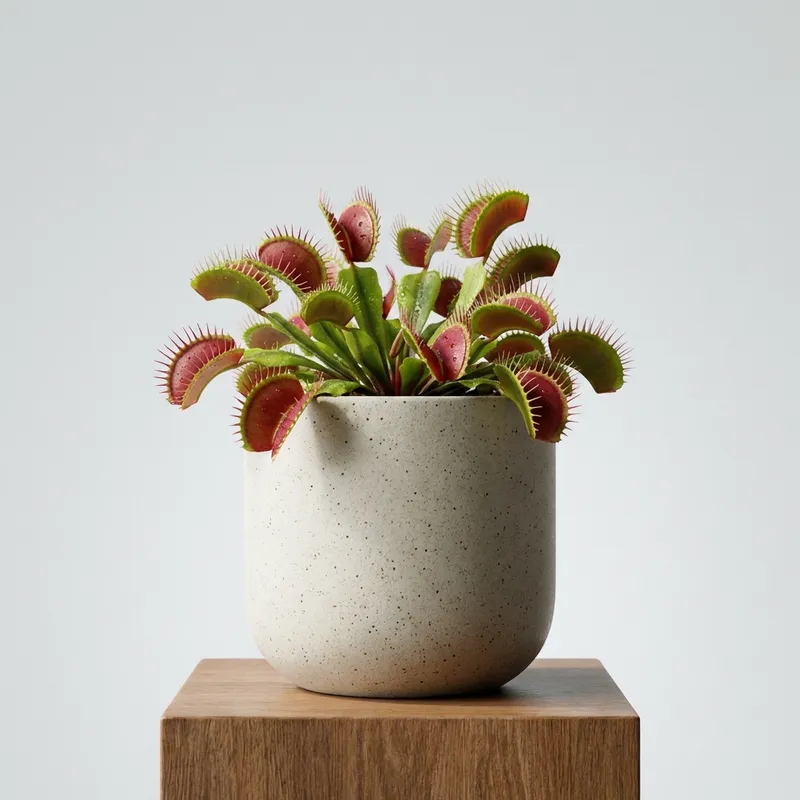
The Venus Flytrap is the world's most iconic carnivorous plant, native only to the boggy wetlands of the Carolinas in the United States. It is famous for its specialized 'snap-trap' leaves that utilize sensitive trigger hairs to detect and capture live insects. When an insect brushes against these hairs twice in quick succession, the trap snaps shut in less than a second, beginning a digestive process that provides the plant with essential nutrients like nitrogen and phosphorus which are absent in its native soil.
Light
Full Sun
Water
High
Difficulty
Difficult
Humidity
High
Pet Friendly
The Venus Flytrap is non-toxic to cats and dogs. However, the plant is fragile, and the traps may be damaged if pets play with or ingest them.
Care Guide
Venus Flytrap (Dionaea muscipula) Care Guide
Light and Location
Venus Flytraps require intense light to thrive and maintain their red interior coloration. Indoors, they should be placed in a south-facing window or under high-intensity LED grow lights for 10-12 hours a day. Outdoors, they prefer full sun.
Water Quality
Crucial: Never use tap, bottled, or filtered water. These contain minerals that cause ‘mineral burn’ and will eventually kill the plant. Use only distilled water, reverse osmosis water, or rainwater.
The Tray Method
Keep the pot sitting in a shallow tray filled with 1-2 inches of pure water at all times. This mimics their native bog environment and ensures the soil never dries out.
Feeding
If the plant is outdoors, it will catch its own food. Indoors, you may feed it a live insect (like a small cricket or fly) once every few weeks. Only feed traps that are fully open, and ensure the insect is no larger than 1/3 the size of the trap. Do not feed ‘human’ food like meat.
Soil and Repotting
Use a nutrient-poor medium, typically a 1:1 mix of pure granulated peat moss and perlite or silica sand. Never use potting soil with added fertilizers (like Miracle-Gro).
Winter Dormancy
Venus Flytraps are not tropical; they are temperate plants. They require a 3-4 month dormancy period during the winter (November to February) where temperatures drop between 35°F and 50°F (2°C to 10°C). During this time, the plant will look ‘dead’ or stop growing, which is normal.
In-Depth Care & Growth
Feeding & Soil
Fertilizer
None
Soil
50% Sphagnum peat moss and 50% perlite or silica sand; must be mineral-free.
Physical Attributes
Mature Size
5 to 6 inches in diameter
Growth Rate
Moderate
Propagation
Rhizome division, leaf pullings, and seed germination.
Common Varieties
B52
The 'B52' is a giant Venus Flytrap variety distinguished by its exceptionally large traps that feature a vibrant deep-red interior and thick, sturdy lime-green petioles.
Akai Ryu' (Red Dragon)
The 'Akai Ryu' Venus Flytrap is distinguished by its striking, uniform deep burgundy to maroon coloration that extends across the entire plant, including both its traps and its stalks.
King Henry
The 'King Henry' variety is distinguished by its exceptionally large traps with deep crimson interiors supported by elongated, upright green petioles that give the plant a towering and vigorous appearance.
DC All Red
The 'DC All Red' Venus Flytrap is distinguished by its uniform, deep burgundy coloration that saturates the entire plant, including the petioles, traps, and teeth.
Low Giant
The 'Low Giant' variety is characterized by its ground-hugging growth habit and oversized traps featuring deep red interiors set against short, broad green petioles.