Tropical Pitcher Plant (Nepenthes)
Nepenthes spp.
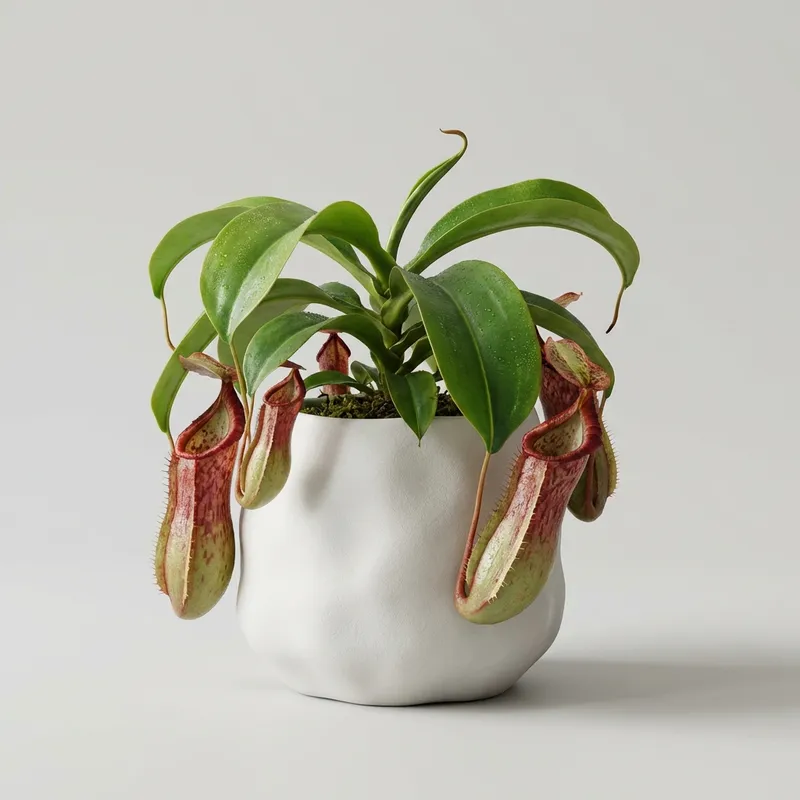
Commonly known as monkey cups, Nepenthes are fascinating carnivorous plants native to the tropics. They are best known for their hanging, jug-like pitchers which are actually modified leaves designed to attract, trap, and digest insects. These exotic plants add a prehistoric and dramatic flair to any high-humidity environment.
Light
Bright Indirect
Water
High
Difficulty
Moderate
Humidity
High
Pet Friendly
Nepenthes are considered non-toxic to cats, dogs, and humans. However, the fluid inside the pitchers is acidic and contains digestive enzymes, which might cause mild stomach upset if ingested.
Care Guide
Nepenthes Care Guide
Light
Nepenthes thrive in bright, indirect light. A window with a sheer curtain is ideal. While they need plenty of light to produce pitchers, direct midday sun can burn the foliage.
Watering
Keep the soil consistently moist but never soggy. It is crucial to use mineral-free water such as distilled water, rainwater, or reverse osmosis water. These plants are extremely sensitive to the minerals found in tap water.
Humidity and Temperature
High humidity (60% to 80%) is essential for the development of pitchers. If the air is too dry, the plant may grow leaves but fail to produce pitchers. Keep temperatures between 65°F and 85°F, avoiding cold drafts or sudden temperature drops.
Soil and Potting
Use a nutrient-poor, airy substrate. A mix of equal parts long-fiber sphagnum moss and perlite or orchid bark works best. Do not use standard potting soil or compost.
Feeding
If the plant is not catching its own insects indoors, you can drop a small, dried insect or a single pellet of slow-release fertilizer into a few of the pitchers once a month.
Seasonal Care
During winter, the plant’s growth will slow down. Reduce watering slightly and ensure it still receives plenty of light and humidity. Prune away dried, brown pitchers at the leaf tip to encourage new growth.
In-Depth Care & Growth
Feeding & Soil
Fertilizer
Diluted orchid fertilizer or freeze-dried insects
Soil
Long-fiber sphagnum moss, perlite, and orchid bark mix.
Physical Attributes
Mature Size
Vining stems can reach 1 to 5 feet indoors.
Growth Rate
Moderate
Propagation
Stem cuttings, basal shoots, and seeds.
Common Varieties
Nepenthes alata
*Nepenthes alata* features lanceolate green leaves and slender, vase-shaped pitchers that are typically pale green with reddish speckles and a narrow, delicately ribbed peristome.
Nepenthes x ventrata
*Nepenthes x ventrata* features glossy, lanceolate green leaves and slender, "waisted" pitchers that are characterized by their vibrant, uniform reddish-orange coloration.
Nepenthes sanguinea
The *Nepenthes sanguinea* is distinguished by its large, leathery, cylindrical pitchers that transition from vibrant orange to a deep, namesake blood-red, emerging from robust, lanceolate leaves.
Nepenthes mirabilis
*Nepenthes mirabilis* is distinguished by its thin, papery lance-shaped leaves and elongated, cylindrical pitchers that range from pale green to reddish-maroon with a narrow, finely ribbed peristome.