
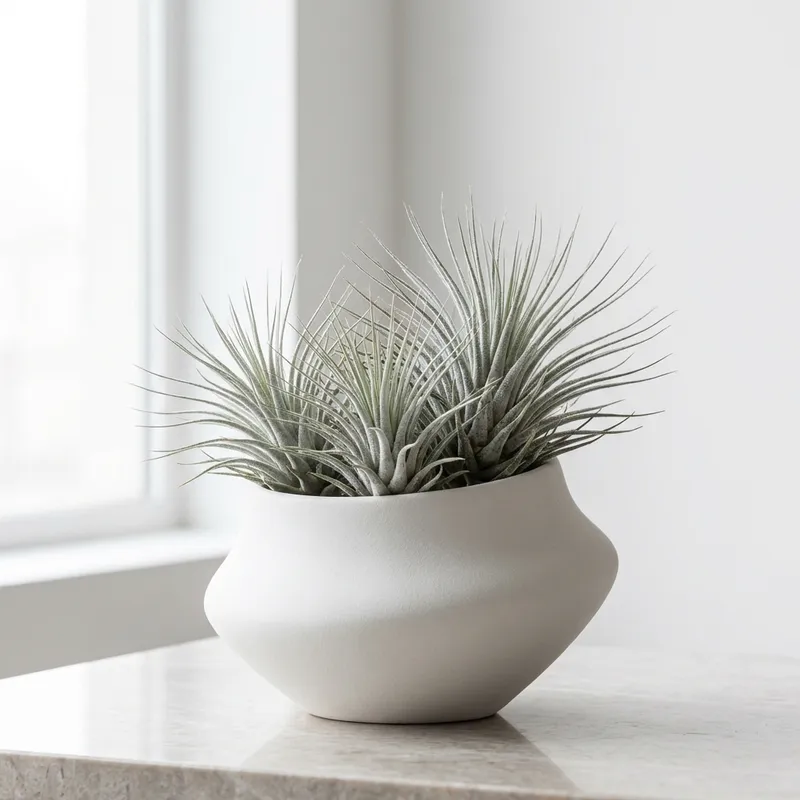
Tillandsia (Air Plant)
Tillandsia spp.
A fascinating genus of over 650 species in the Bromeliaceae family, native to the diverse climates of the Americas. As epiphytes, these unique plants do not require soil to grow, instead clinging to trees or rocks in the wild. They utilize specialized silver scales on their leaves called trichomes to absorb moisture and nutrients directly from the air and rainfall, making them a marvel of botanical adaptation.
Light
Bright Indirect
Water
Moderate
Difficulty
Moderate
Humidity
High
Pet Friendly
Tillandsia species are non-toxic to cats, dogs, and horses, making them excellent choices for pet-friendly households.
Care Guide
Watering Protocol
Soak your Tillandsia in a bowl of room-temperature water for 20-30 minutes once a week.
Crucial: After soaking, shake off all excess water and place the plant upside down on a clean towel in a well-ventilated area. It must dry completely within 4 hours to prevent crown rot.
Light and Airflow
Place in a spot with bright, filtered sunlight. Avoid direct afternoon sun which can dehydrate and burn the leaves. Good air circulation is vital; do not keep them in enclosed terrariums for long periods without ventilation.
Temperature
Keep your air plants in temperatures between 50°F and 90°F. They are not frost-tolerant and should be moved away from drafty windows during winter months.
Common Issues
Brown, crispy tips: Indicates underwatering or low humidity.
Black or soggy base: Indicates rot from trapped water. Immediately remove affected leaves and ensure better drying practices.
In-Depth Care & Growth
Feeding & Soil
Fertilizer
Bromeliad or Air Plant specific liquid fertilizer (low-copper)
Soil
None; these plants are epiphytic and will rot if planted in traditional potting soil.
Physical Attributes
Mature Size
2 inches to 3 feet depending on species
Growth Rate
Slow
Propagation
Division of 'pups' (offsets) that grow at the base of the mother plant after its flowering cycle.
Common Varieties
T. ionantha
Tillandsia ionantha is a compact, rosette-forming air plant featuring silvery-green, spiky leaves that blush a vibrant crimson or pink when the plant prepares to bloom.
T. xerographica
*Tillandsia xerographica* is a sculptural air plant distinguished by its large rosette of broad, silvery-gray leaves that taper and gracefully spiral into elegant, recurved curls.
T. bulbosa
*Tillandsia bulbosa* is characterized by its prominent, swollen base and smooth, leathery, dark green leaves that twist outward like tentacles and often blush with deep purple or red tones.
T. usneoides (Spanish Moss)
*Tillandsia usneoides* is distinguished by its long, pendulous strands of slender, silvery-gray leaves that form delicate, cascading mats.
T. caput-medusae
*Tillandsia caput-medusae* is characterized by its swollen, bulbous base and thick, snake-like, silvery-green leaves that twist and curl, often covered in a fine, velvety layer of gray trichomes.