
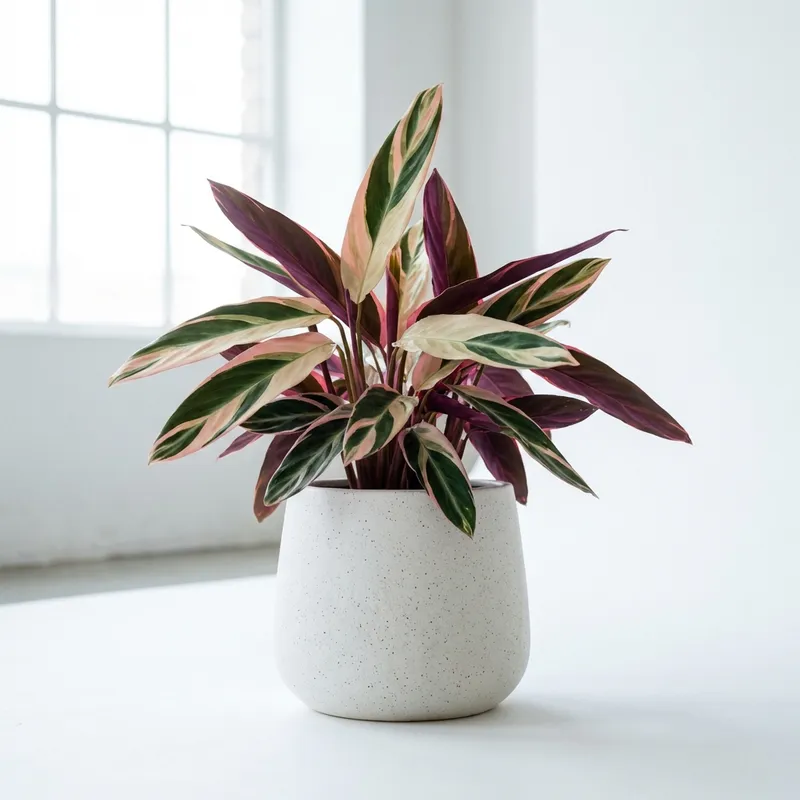
Stromanthe Triostar
Stromanthe thalia 'Triostar'
The Stromanthe Triostar is a breathtaking member of the Marantaceae family, prized for its dramatic, multicolored foliage. Each lance-shaped leaf is a unique canvas of emerald green, creamy white, and soft pink streaks, while the underside reveals a deep, vibrant burgundy. As a 'prayer plant' relative, its leaves exhibit nyctinasty, moving upward at night to reveal their colorful undersides and opening back up during the day to capture light, making it a dynamic and visually stunning addition to any indoor collection.
Light
Bright Indirect
Water
High
Difficulty
Moderate
Humidity
High
Pet Friendly
This plant is non-toxic to cats and dogs, making it a safe choice for pet owners.
Care Guide
Light
Position your Triostar in bright, indirect light to maintain its vivid variegation. Avoid direct sunlight, which can burn the delicate leaves, or low-light conditions, which may cause the pink and white patterns to fade to green.
Water
This plant prefers to stay consistently moist but never soggy. Water when the top 1 inch of soil feels dry. It is highly sensitive to minerals in tap water, so use distilled, filtered, or rainwater to prevent leaf tip burn.
Humidity & Temperature
High humidity is critical—aim for 60% or higher. Use a humidifier or a pebble tray. Keep the plant in a warm spot between 65-80°F (18-27°C) and away from cold drafts or heater vents.
Soil & Repotting
Use a well-draining potting mix rich in organic matter. Repot every 1-2 years in spring if the plant becomes root-bound.
Troubleshooting
Crispy edges: Increase humidity and check water quality. *
Drooping leaves: Usually indicates the soil is too dry. *
Yellowing leaves: Often a sign of overwatering or poor drainage.
In-Depth Care & Growth
Feeding & Soil
Fertilizer
Liquid balanced houseplant fertilizer diluted to half-strength
Soil
Peat-based potting mix with perlite or orchid bark for drainage.
Physical Attributes
Mature Size
2-3 feet tall, 1-2 feet wide
Growth Rate
Moderate
Propagation
Division of the root clump during spring repotting.
Common Varieties
Triostar
The 'Triostar' variety is distinguished by its elegant, lance-shaped leaves that feature a striking variegated pattern of cream, pink, and emerald green on the upper surface, beautifully contrasted by a vivid magenta-pink underside.
Magicstar
The 'Magicstar' variety is distinguished by its elongated, lance-shaped leaves of deep green featuring fine, star-like white speckling that contrasts sharply with its vibrant burgundy-pink undersides.