
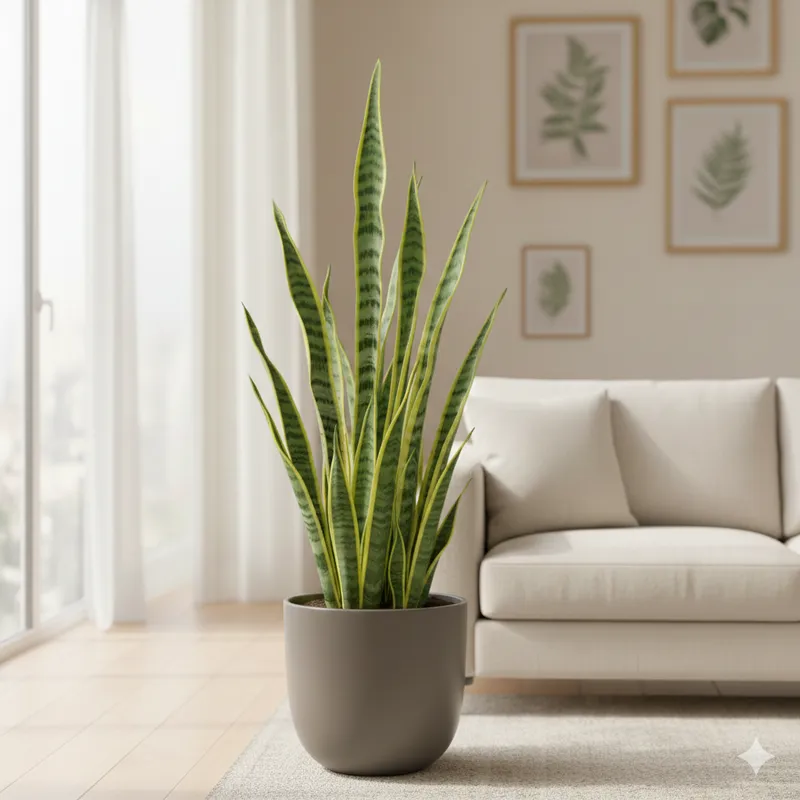
Snake Plant
Dracaena trifasciata
An incredibly resilient and architecturally striking plant known for its upright, sword-like leaves. It is a staple in interior design due to its ability to thrive on neglect and its air-purifying qualities, specifically its ability to convert carbon dioxide into oxygen at night.
Light
Low
Water
Low
Difficulty
Easy
Humidity
Low
Pet Warning
Toxic to cats and dogs if ingested. Contains saponins which can cause nausea, vomiting, and diarrhea.
Care Guide
Snake Plant Care Guide
1. Lighting While it thrives in bright indirect light, it is famous for surviving in low-light corners of the home. Avoid direct hot sun which can scorch the leaves.
2. Watering Allow the soil to dry out completely between waterings. Overwatering is the most common cause of failure; when in doubt, wait a week. In winter, water only once every 6-8 weeks.
3. Soil & Potting Use a well-draining potting mix, such as a cactus or succulent blend. Ensure the pot has substantial drainage holes to prevent standing water.
4. Temperature Maintain temperatures between 60°F and 85°F (15°C - 30°C). Keep away from cold drafts and air conditioning vents.
5. Common Issues
Mushy leaves: Sign of root rot from overwatering. Remove affected leaves and reduce watering.
Wrinkled leaves: Indicates the plant is severely dehydrated.
Leaning leaves: Usually caused by insufficient light or incorrect watering.
In-Depth Care & Growth
Feeding & Soil
Fertilizer
Balanced liquid fertilizer
Soil
Well-draining, sandy potting mix or cactus/succulent soil.
Physical Attributes
Mature Size
1 to 4 feet tall
Growth Rate
Slow
Propagation
Division of rhizomes or leaf cuttings.
Common Varieties
Laurentii (yellow edges)
The 'Laurentii' variety features stiff, sword-shaped leaves characterized by a dark green, marbled center framed by bold, golden-yellow margins.
Zeylanica (silver-green bands)
The 'Zeylanica' variety features upright, sword-shaped leaves characterized by a striking pattern of horizontal, silvery-green wavy bands set against a deep green backdrop.
Moonshine (pale silvery-green)
The 'Moonshine' variety features broad, upright, sword-shaped leaves distinguished by a luminous, pale silvery-green color that typically lacks the dark horizontal banding found in other snake plants.
Futura Robusta (short and wide).
This compact variety features short, broad leaves with a distinct silvery-green sheen and dark green horizontal banding, growing in a dense, sturdy rosette.
Moonshine Snake Plant
The 'Moonshine' is a sleek, modern succulent featuring broad, silvery-green leaves that stand upright in a tight rosette. Its ethereal, metallic appearance makes it a favorite for minimalist decor. It is incredibly hardy, acting as an excellent air purifier while requiring very little maintenance.
Whale Fin Sansevieria
The Dracaena masoniana, commonly known as the Whale Fin Snake Plant, is a striking succulent characterized by its singular, massive, paddle-shaped leaf. Its dark green surface is adorned with beautiful light green mottled patterns, making it look like a piece of living art. This slow-growing plant is highly sought after by collectors for its unique architectural form and minimalist aesthetic.
Bird's Nest Snake Plant
The Bird's Nest Snake Plant is a charming, compact version of the classic snake plant. Unlike its tall, sword-shaped relatives, 'Hahnii' forms low-growing, tight rosettes of broad, funnel-shaped leaves. Its architectural form and striking silver-green marbling make it an ideal choice for tabletops and small spaces. This plant is legendary for its durability and air-purifying qualities, thriving even when neglected.
Sansevieria cylindrica
The Sansevieria cylindrica, also known as the Cylindrical Snake Plant or African Spear, is a visually striking succulent characterized by its upright, round, spear-like foliage. These smooth, green leaves grow in a distinct fan-like pattern, providing an architectural and modern aesthetic. Known for its extreme durability and air-purifying qualities, it is one of the most resilient indoor plants available.