
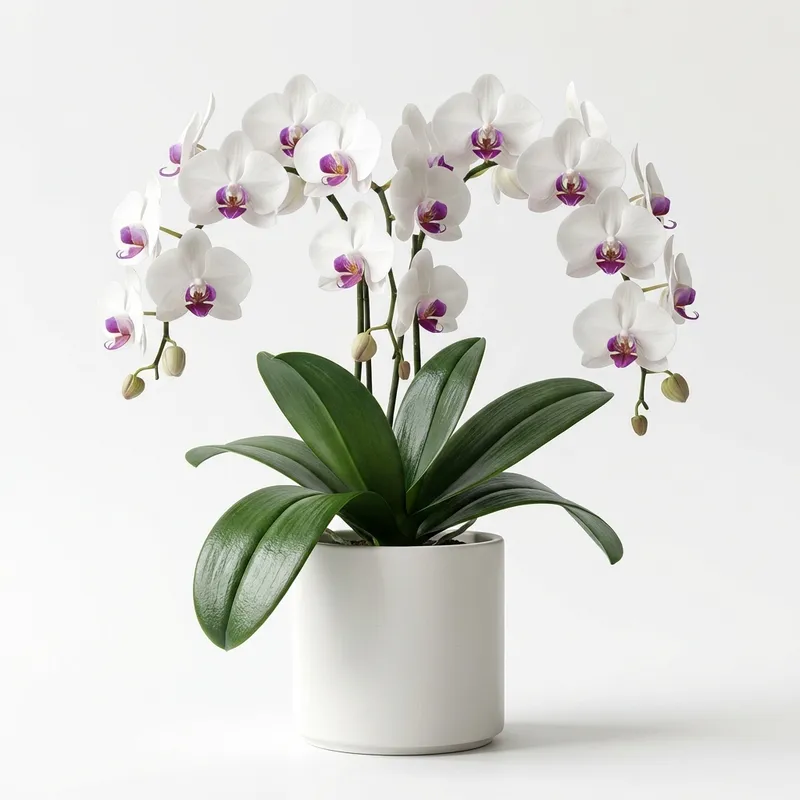
Moth Orchid
Phalaenopsis
The Phalaenopsis orchid, commonly known as the Moth Orchid, is prized for its elegant, long-lasting blooms that resemble the wings of a moth. Native to Southeast Asia, these epiphytic plants grow on trees in the wild, drawing moisture and nutrients from the air and rain. They are among the most popular indoor orchids because they thrive in typical household conditions and can bloom for several months at a time.
Light
Bright Indirect
Water
Moderate
Difficulty
Moderate
Humidity
Moderate
Pet Friendly
Phalaenopsis orchids are considered non-toxic to cats and dogs by the ASPCA.
Care Guide
Light
Place in bright, filtered light such as an east-facing window. Avoid direct midday sun which can burn the thick, leathery leaves.
Watering
Water approximately once a week when the potting medium feels nearly dry. Use lukewarm water and avoid getting water into the crown (center of the leaves), as this can cause rot. If possible, water in the morning.
Temperature and Humidity
Ideal temperatures are between 65°F and 85°F. To encourage blooming, a slight drop in temperature at night during the fall can be beneficial. Maintain humidity between 50-70% using a pebble tray or humidifier.
After-Bloom Care
When the flowers fade, you can cut the spike back to the base to let the plant rest, or cut just above the last node to encourage a secondary flush of flowers.
Repotting
Repot every 1-2 years using a dedicated orchid bark mix once the medium begins to break down or the roots outgrow the pot.
In-Depth Care & Growth
Feeding & Soil
Fertilizer
Balanced orchid fertilizer (20-20-20)
Soil
Orchid bark, sphagnum moss, or a mix of perlite and charcoal
Physical Attributes
Mature Size
1-3 feet tall
Growth Rate
Slow
Propagation
Keiki (baby plant) division or stem cuttings
Common Varieties
Phalaenopsis amabilis
*Phalaenopsis amabilis* is characterized by its thick, leathery, oblong leaves that are a solid, glossy dark green and notably lack any mottling or patterns.
Phalaenopsis schilleriana
*Phalaenopsis schilleriana* is distinguished by its broad, oblong leaves that feature a striking silver-gray marbled pattern over a dark green base, often complemented by a deep purple underside.
Phalaenopsis aphrodite
*Phalaenopsis aphrodite* is characterized by its thick, glossy, deep green elliptical leaves that are typically uniform in color and often exhibit a subtle reddish-purple tint on their undersides.