
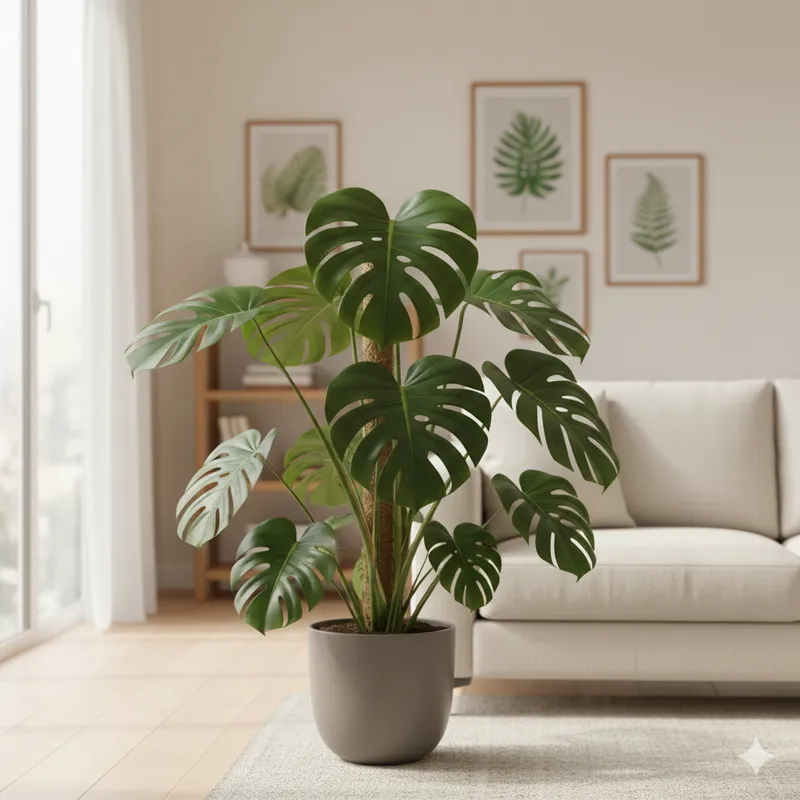
Monstera deliciosa
Monstera deliciosa
The Monstera deliciosa, commonly known as the Swiss Cheese Plant, is a striking tropical perennial from the Araceae family. Native to the rainforests of Central America, it is celebrated for its massive, glossy green leaves that develop unique natural holes and splits known as fenestrations. In its natural habitat, it is an epiphytic climber, using thick aerial roots to scale trees and reach for the light. It has become a staple of modern interior design due to its architectural presence and relatively forgiving nature.
Light
Bright Indirect
Water
Moderate
Difficulty
Easy
Humidity
High
Pet Warning
Contains insoluble calcium oxalate crystals. If ingested, it can cause significant irritation to the mouth, lips, and tongue, excessive drooling, vomiting, and difficulty swallowing in cats and dogs.
Care Guide
Light
Monstera deliciosa thrives in bright, filtered sunlight. While it can tolerate lower light conditions, its growth will slow and leaves may remain small without the iconic holes. Avoid direct midday sun, which can scorch the foliage.
Water
Wait until the top 2-3 inches of soil are completely dry before watering. Saturate the soil until water runs out of the drainage holes. During winter, reduce watering frequency as growth slows.
Humidity & Temperature
Maintain a humid environment (60%+) and temperatures between 65-85°F (18-29°C). Keep the plant away from cold drafts and heating vents.
Support
Provide a moss pole or trellis to encourage climbing. As the plant grows, use soft plant ties to secure the thick stems to the support structure.
Cleaning
Wipe the large leaves with a damp cloth every few weeks to remove dust, which allows the plant to photosynthesize more efficiently and prevents pests like spider mites.
In-Depth Care & Growth
Feeding & Soil
Fertilizer
Balanced liquid fertilizer (20-20-20)
Soil
A well-aerated, chunky mix containing peat moss or coco coir, perlite, and orchid bark.
Physical Attributes
Mature Size
10 to 15 feet tall indoors; leaves up to 3 feet wide
Growth Rate
Fast
Propagation
Stem cuttings with at least one node and an aerial root, or air layering.
Common Varieties
Borsigiana
The 'Borsigiana' variety features smaller, deep-green heart-shaped leaves with characteristic fenestrations and a smooth petiole that lacks the wrinkled texture found on the standard *Monstera deliciosa*.
Variegata (Albo)
The 'Variegata (Albo)' variety is distinguished by its large, iconic fenestrated leaves that feature a striking, high-contrast mix of deep green and brilliant white patches, splashes, or marbling.
Thai Constellation
The 'Thai Constellation' *Monstera deliciosa* is characterized by its large, fenestrated green leaves uniquely patterned with stable, starry speckles and creamy-white splashes.
Tauerii
The 'Tauerii' is a compact, dwarf variety of *Monstera deliciosa* characterized by its glossy, deep green, heart-shaped leaves that develop their signature fenestrations at a much earlier stage of maturity than the standard species.
Monstera adansonii
The Monstera adansonii, commonly known as the Swiss Cheese Vine, is a striking tropical perennial famous for its unique heart-shaped leaves adorned with natural oval-shaped holes called fenestrations. Unlike its larger cousin, Monstera deliciosa, this species remains more compact and exhibits a vigorous climbing or trailing habit, making it perfect for hanging baskets or moss poles. Its lush green foliage adds a sophisticated jungle aesthetic to any indoor space while being relatively adaptable to home environments.
Monstera 'Burle Marx Flame
The Monstera 'Burle Marx Flame' is a legendary aroid coveted for its architectural beauty and dramatic, deeply fenestrated leaves. Unlike the broad leaves of a typical deliciosa, this specimen features narrow, finger-like lobes that curve upwards like flickering flames. It is a slow-growing climber that transforms any space into a tropical gallery, making it a crown jewel for serious rare plant collectors.
Monstera Dubia
Commonly known as the Shingle Plant, Monstera dubia is a fascinating tropical hemiepiphyte native to Central and South America. It is renowned for its dramatic transformation; in its juvenile stage, it features small, heart-shaped, silver-variegated leaves that press flat against a host surface. As it matures and climbs, it develops much larger, deep green leaves with impressive fenestrations, eventually losing its shingling habit once it reaches the canopy.
Monstera esqueleto
Monstera esqueleto is a breathtaking tropical aroid native to the cloud forests of Costa Rica. It is renowned for its large, leathery leaves that exhibit dramatic, oversized fenestrations, often appearing more like a delicate skeleton than a solid leaf. While frequently confused with its smaller relative, Monstera adansonii, the esqueleto boasts much larger foliage, a more deeply textured surface, and a unique growth habit that rewards indoor gardeners with an architectural centerpiece as it matures.
Monstera obliqua
Often referred to as the 'holy grail' of aroids, the Monstera obliqua is a rare and elusive species known for its exceptionally thin, paper-like leaves. What makes this plant so distinct is its extreme fenestration; in mature specimens, the holes can account for up to 90% of the leaf surface, leaving only a delicate, lace-like skeleton of green. It is a slow-growing climber that is frequently confused with the more common Monstera adansonii, though the true obliqua is significantly more fragile and difficult to cultivate.
Monstera pinnatipartita
A captivating tropical climber native to the rainforests of South America, Monstera pinnatipartita is beloved for its dramatic ontogenetic leaf transformation. In its juvenile form, the leaves are entire, oval-shaped, and display a bullate (bumpy) texture with a subtle silvery-green sheen. As the plant matures and is given the opportunity to climb, the foliage undergoes a stunning metamorphosis, developing deep, pinnate splits that extend almost to the midrib, eventually resembling the large, fenestrated leaves of its more famous relatives.
Monstera standleyana
Commonly known as the 'Cobra Plant', Monstera standleyana is a sophisticated vining aroid native to Central America. Unlike its famous relative, Monstera deliciosa, it produces elongated, lance-shaped leaves that rarely develop fenestrations. It is highly prized for its 'Albo Variegata' form, which features a mesmerizing array of creamy white speckles, splashes, and broad sectoral stripes against a deep, glossy green backdrop. As a hemiepiphyte, it is naturally inclined to climb, making it a striking choice for vertical indoor gardens.