
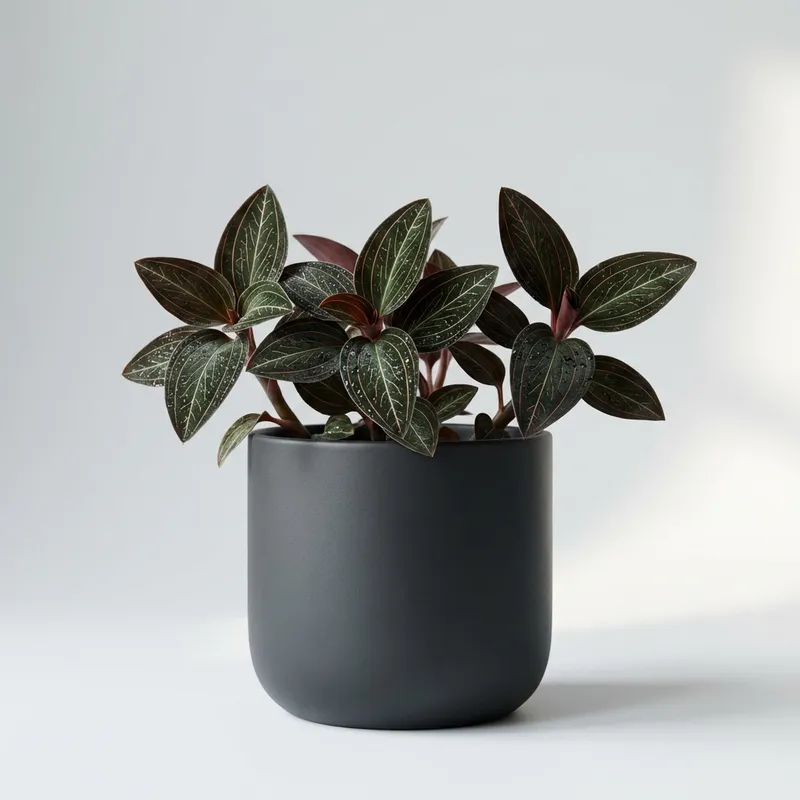
Jewel Orchid
Ludisia discolor
The Jewel Orchid is a unique terrestrial orchid prized not for its blooms, but for its stunning, velvety foliage. Its leaves are deep maroon, almost black, adorned with delicate, shimmering silver or reddish-gold veins that catch the light. Originating from the forest floors of Southeast Asia, this plant adds a touch of gothic elegance to any indoor garden and is significantly easier to care for than many of its epiphytic orchid relatives.
Light
Low
Water
Moderate
Difficulty
Easy
Humidity
High
Pet Friendly
Ludisia discolor is generally considered non-toxic to cats, dogs, and horses, making it a safe choice for pet owners.
Care Guide
Jewel Orchid Care Guide
Lighting: Unlike most orchids, the Jewel Orchid thrives in low to medium indirect light. Direct sunlight will bleach the beautiful dark colors of the leaves and can cause scorching.
Watering: Maintain consistent moisture in the substrate. Water when the top surface of the soil feels dry to the touch, but do not let the plant sit in standing water as this leads to root rot.
Humidity: This plant loves high humidity (50% or higher). It is an excellent candidate for terrariums. If kept in the open, use a humidifier or a pebble tray to increase local moisture.
Temperature: Keep in a warm environment between 60°F and 80°F. Avoid placing near cold drafts or heating vents.
Soil & Potting: As a terrestrial orchid, it needs a specialized mix. A blend of peat moss, perlite, and fine orchid bark works best to provide drainage while retaining moisture.
Maintenance: Trim spent flower spikes at the base to redirect energy to foliage growth. Repot every 1-2 years to refresh the substrate.
In-Depth Care & Growth
Feeding & Soil
Fertilizer
Balanced liquid fertilizer diluted to quarter-strength
Soil
Well-draining terrestrial mix (peat, perlite, and fine orchid bark)
Physical Attributes
Mature Size
6-12 inches tall, spreading horizontally
Growth Rate
Moderate
Propagation
Stem cuttings, division of the rhizome
Common Varieties
Ludisia discolor 'Dawsoniana
*Ludisia discolor* 'Dawsoniana' is characterized by its broad, velvety, deep-maroon to near-black leaves intricately patterned with a network of luminous, copper-red pinstripe veins.
Ludisia discolor 'Alba
*Ludisia discolor* 'Alba' is characterized by its velvety, emerald-green lanceolate leaves adorned with striking longitudinal silvery-white pinstripes.
Ludisia discolor 'Nigrescens
*Ludisia discolor* 'Nigrescens' is distinguished by its velvety, near-black elliptical foliage accented by a single, prominent silver pinstripe running down the center of each leaf.