
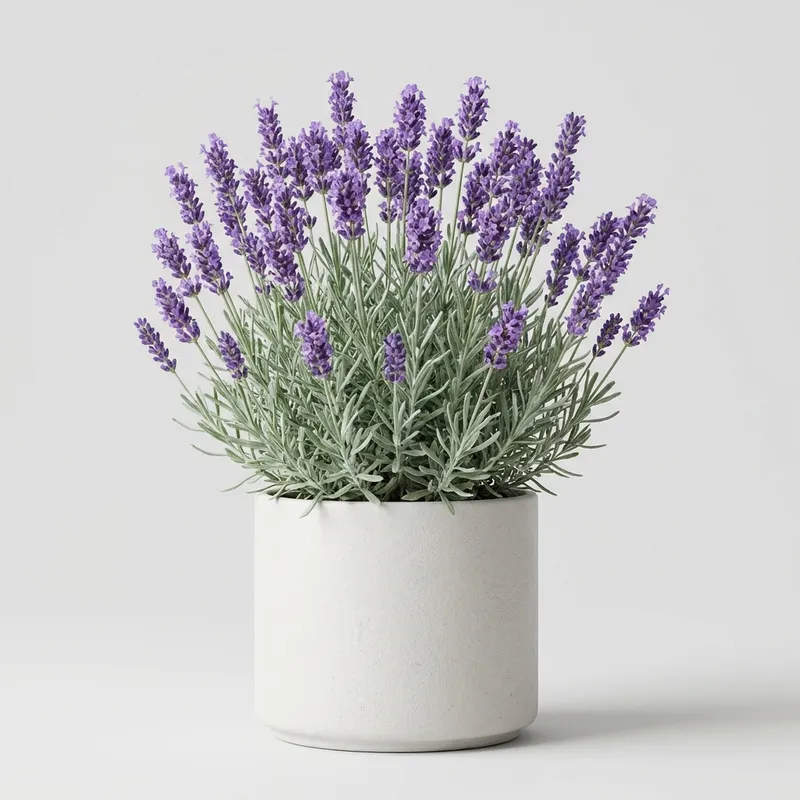
English Lavender
Lavandula angustifolia
An iconic Mediterranean perennial known for its aromatic foliage and stunning spikes of purple flowers. English Lavender is a staple in fragrant gardens and is widely used for its calming essential oils and culinary properties. It is a hardy, woody shrub that thrives in sunny, well-drained conditions.
Light
Full Sun
Water
Low
Difficulty
Moderate
Humidity
Low
Pet Warning
Contains linalool and linalyl acetate, which can be toxic to cats, dogs, and horses if ingested in large quantities, potentially causing gastrointestinal upset or central nervous system depression.
Care Guide
Light
Place in the brightest spot possible, ideally a south-facing window receiving at least 6-8 hours of direct sunlight. If grown indoors without sufficient light, it may become leggy and fail to bloom.
Water
Water deeply but infrequently. Allow the top 2 inches of soil to dry out completely before watering again. English Lavender is drought-tolerant but extremely sensitive to root rot caused by overwatering.
Soil and Potting
Use a gritty, well-draining potting mix. A mix of potting soil with added perlite, gravel, or sand works well. Ensure the pot has ample drainage holes to prevent moisture buildup.
Pruning
Prune lightly after the first flush of flowers to encourage a second bloom. Perform a harder prune in late summer to maintain a compact shape and prevent the plant from becoming overly woody at the base.
Seasonal Care
In winter, move the plant to a cooler room away from heating vents to mimic its natural dormant period, but maintain high light levels. Reduce watering significantly during the cold months.
In-Depth Care & Growth
Feeding & Soil
Fertilizer
Balanced slow-release fertilizer or organic compost
Soil
Well-draining, sandy, or gravelly soil with a neutral to slightly alkaline pH.
Physical Attributes
Mature Size
1 to 3 feet tall and wide
Growth Rate
Moderate
Propagation
Semi-hardwood cuttings taken in summer or softwood cuttings in spring. Can also be grown from seeds, though germination is slow.
Common Varieties
Munstead
Munstead' is a compact, mounded cultivar distinguished by its narrow, linear leaves that display a soft, muted silvery-green coloration.
Hidcote
Hidcote' is a compact lavender variety distinguished by its narrow, lance-shaped, silver-gray foliage that grows in a dense, mounding pattern.
Vera
The 'Vera' variety is distinguished by its narrow, linear leaves that exhibit a striking silvery-gray coloration and form a dense, upright mounded silhouette.
Rosea
The 'Rosea' variety features narrow, linear leaves with a soft silvery-green hue, arranged in a dense, upright pattern that provides a fine-textured appearance to its compact frame.
Loddon Blue
This compact dwarf variety is characterized by its narrow, linear foliage that displays a distinctive silvery-grey hue and forms a dense, uniform mound.