
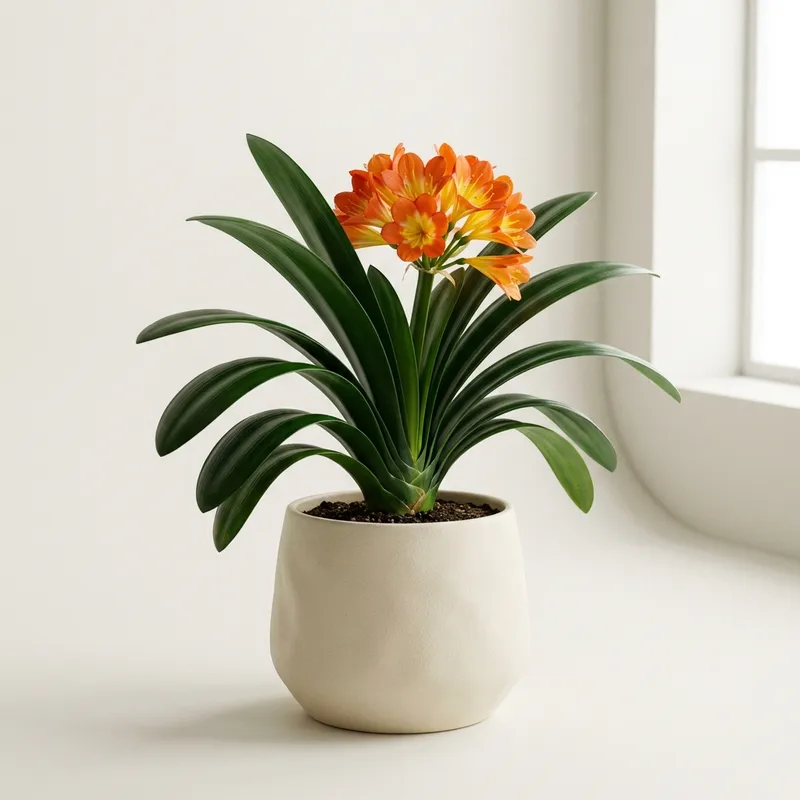
Clivia miniata
Clivia miniata
A member of the Amaryllis family, Clivia miniata is an elegant, slow-growing perennial favored for its arching, strap-shaped leaves and spectacular umbels of trumpet-shaped flowers. Native to South Africa, it is a resilient houseplant that thrives in low-light conditions where other flowering plants might struggle. Over time, it develops into a dense clump, making it a stunning architectural addition to indoor spaces.
Light
Bright Indirect
Water
Moderate
Difficulty
Moderate
Humidity
Moderate
Pet Warning
All parts of the plant are toxic if ingested. It contains lycorine, which can cause vomiting, diarrhea, drooling, and in large amounts, more severe symptoms like convulsions or low blood pressure.
Care Guide
Light and Placement Clivia prefers bright, filtered light. Avoid direct sunlight, especially in the afternoon, as the leaves are prone to scorching. North or east-facing windows are ideal. They can tolerate lower light but may fail to flower.
Watering Routine Water thoroughly when the top 50% of the soil is dry. Clivias have thick, fleshy roots that store water, making them susceptible to root rot if overwatered. Reduce watering significantly in the winter.
Inducing Blooms: The Winter Rest To ensure flowering, Clivia requires a cool, dry rest period for 12-14 weeks starting in late autumn. Keep the plant in a cool spot (approx. 50°F/10°C) and provide very little water—just enough to keep the foliage from wilting. Once the flower stalk emerges in spring, gradually return to normal watering and warmer temperatures.
Potting and Maintenance These plants prefer to be slightly root-bound. Only repot every 3 to 5 years. Use a heavy pot to prevent the plant from tipping over as it matures. Wipe the broad leaves regularly with a damp cloth to remove dust and maintain photosynthesis.
In-Depth Care & Growth
Feeding & Soil
Fertilizer
Balanced 20-20-20 water-soluble fertilizer
Soil
Well-aerated, chunky potting mix high in organic matter with added perlite or orchid bark for drainage.
Physical Attributes
Mature Size
18 to 24 inches tall and wide
Growth Rate
Slow
Propagation
Division of offsets (pups) or through seeds (though seeds take several years to reach flowering maturity).
Common Varieties
Citrina (yellow-flowered)
The 'Citrina' variety is characterized by its robust, arching, strap-shaped leaves of a deep, uniform green that grow in a symmetrical, fan-like arrangement.
Fireball
The 'Fireball' variety is distinguished by its broad, arching, strap-shaped leaves featuring a bold pattern of creamy-yellow longitudinal variegation against a deep green base.
Monet
The 'Monet' variety of *Clivia miniata* is distinguished by its broad, strap-like leaves that feature a soft, painterly "ghost" variegation of creamy-white or pale yellow accented by thin, longitudinal green stripes.
French Hybrids
French Hybrids are characterized by their remarkably broad, dark green, and blunt-ended strap-like leaves that create a robust, compact fan-shaped profile.