
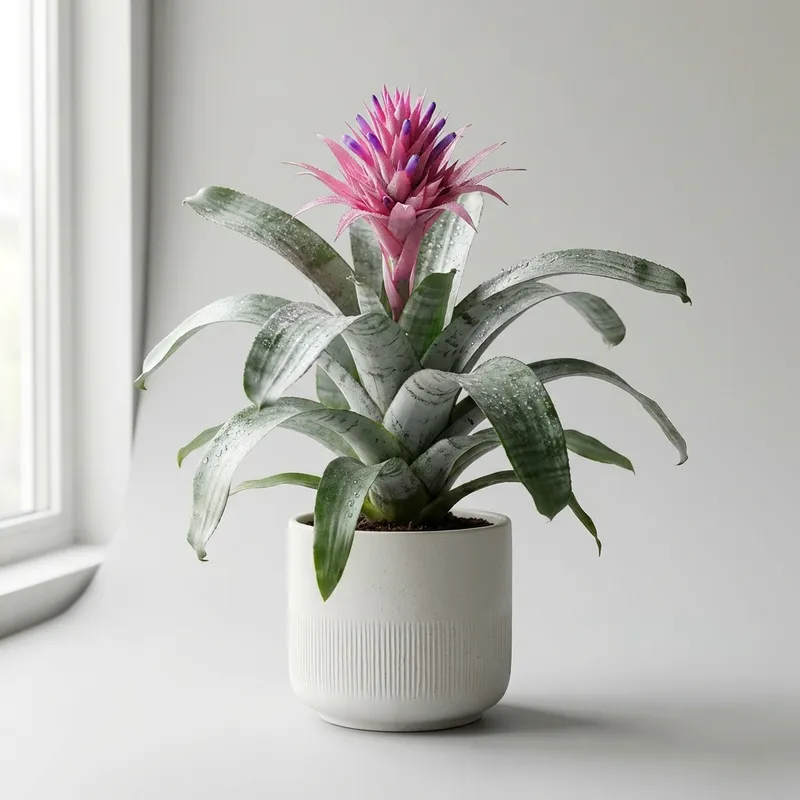
Bromeliad
Bromeliaceae
A vibrant family of tropical plants famous for their rosette-shaped foliage and long-lasting, exotic blooms. Many species are epiphytic, meaning they grow on other plants or trees in nature, absorbing water through a central 'tank' formed by their leaves.
Light
Bright Indirect
Water
Moderate
Difficulty
Easy
Humidity
High
Pet Friendly
Most common household bromeliads are considered non-toxic to pets. However, some species have sharp spines along the leaf margins that can cause minor physical injury.
Care Guide
Bromeliad Care Basics -
Watering: For tank-type bromeliads, keep the central cup filled with fresh water and flush it regularly.
The soil should remain slightly damp but not waterlogged. -
Light: Provide bright, filtered sunlight; avoid direct midday sun which can scorch the leaves. -
Temperature: Maintain a range between 65 and 85 degrees Fahrenheit. -
Flowering: Most bromeliads bloom only once in their lifetime. After the bloom fades, the plant will produce offsets or ‘pups’ at the base. Once pups are roughly one-third the size of the parent, they can be removed and repotted as new plants.
In-Depth Care & Growth
Feeding & Soil
Fertilizer
Water-soluble balanced fertilizer
Soil
Well-aerated, fast-draining potting mix such as an orchid bark mix or a peat-perlite blend.
Physical Attributes
Mature Size
1 to 3 feet depending on species
Growth Rate
Moderate
Propagation
Removal and repotting of offsets (pups)
Common Varieties
Guzmania Lingulata
The *Guzmania lingulata* is characterized by its glossy, strap-like green foliage and a striking central rosette of star-shaped, vibrantly colored bracts that rise like a tropical fountain.
Aechmea Fasciata
The *Aechmea fasciata* features a stiff, upright rosette of arching, silver-green leaves distinguished by their striking horizontal white bands and serrated margins.
Neoregelia
Neoregelia is a low-growing bromeliad characterized by a broad rosette of strap-shaped, often vibrantly patterned or variegated leaves that develop a brilliant, contrasting color in the central cup as the plant nears maturity.
Vriesea Splendens
The *Vriesea splendens* is characterized by its broad, sword-shaped green leaves that are uniquely marked with bold, dark-purple horizontal bands and arranged in a striking architectural rosette.
Tillandsia
Tillandsia species are characterized by their diverse, often spiraling rosettes of slender, tapering leaves that frequently exhibit a frosted, silvery-grey hue and a fine, velvety texture created by specialized water-absorbing scales.