
The Ultimate African Violet Protocol
A comprehensive horticultural guide to Saintpaulia success. Learn the mechanics of photobiology, water physics, and surgical rejuvenation.
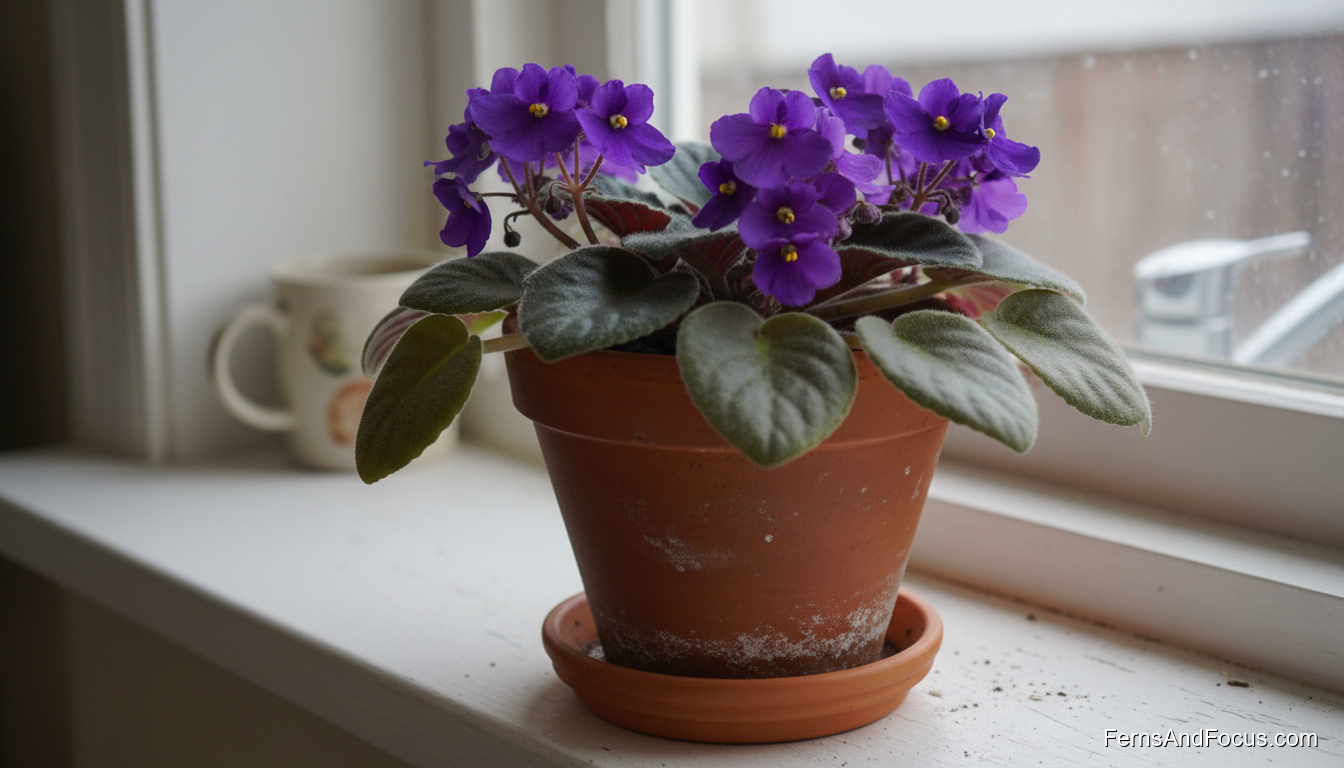
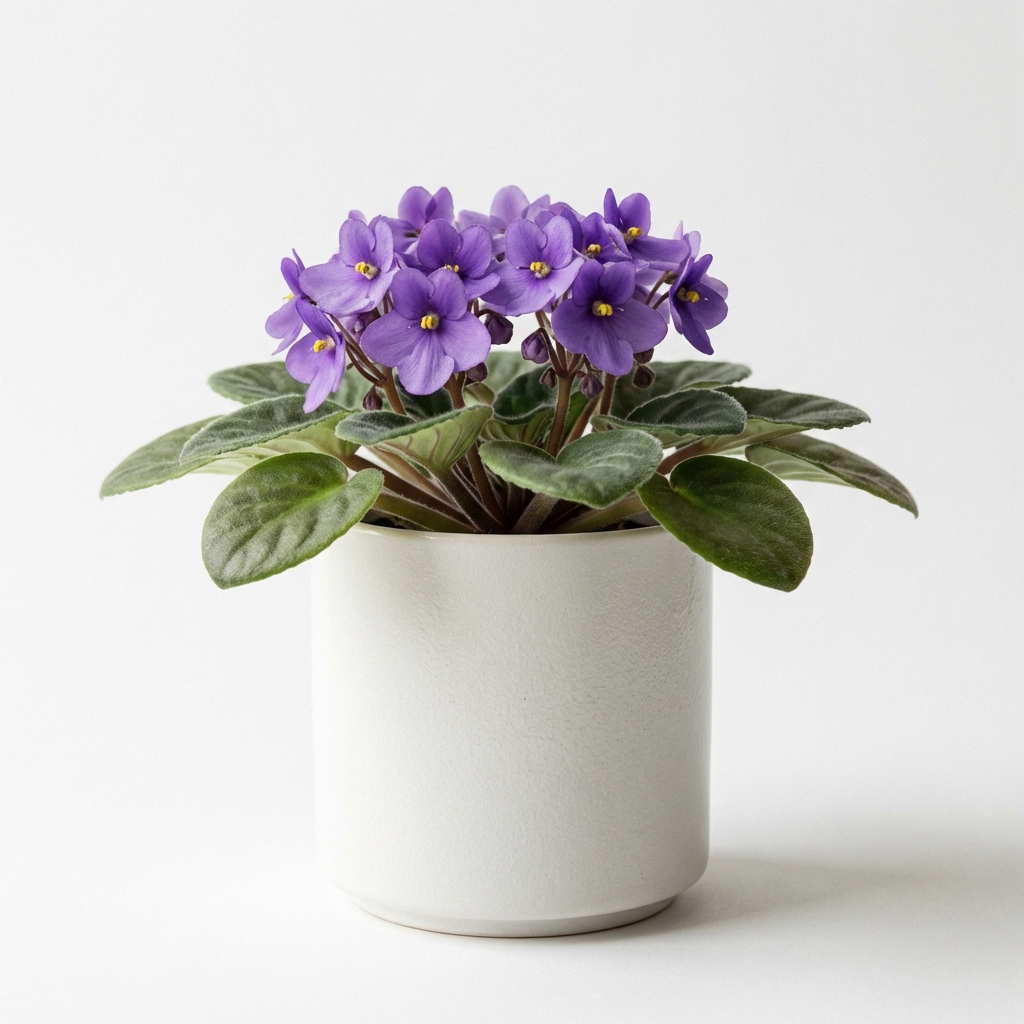
African Violet
Saintpaulia ionantha
Care Level
Moderate
Light
Bright Indirect
Water
Moderate
Humidity
Moderate
The Quick Dirt
If you want an African Violet that blooms all year, you have to stop treating it like a decoration and start treating it like a biological machine. They require a strict 14-hour light cycle, precise substrate physics, and a “Weekly-Weakly” feeding system. This guide is about the specific, non-negotiable moves that transition a violet from surviving to thriving.
Photobiology: The Bloom Catalyst
If your violet has lush green leaves but hasn’t shown a flower in months, light is your limiting factor. These plants operate on a strict internal clock. To trigger flower production, they need between 14 and 16 hours of high-quality, filtered light every single day. If you rely on a window, an east or northeast exposure is ideal because it provides bright light without the destructive heat of the afternoon sun.
But here is the part most people get wrong: the dark period is mandatory. You must provide 8 to 10 hours of total darkness. During this time, the plant finishes its metabolic work, moving the energy it gathered during the day down into the tissues where buds are formed. Without this “energy translocation” phase, the plant stays in a permanent vegetative state. If you find your window light is inconsistent, move to a simple LED or fluorescent setup on a timer. It removes the guesswork and ensures the plant gets exactly the photons it needs to keep those blooms coming year-round.
Thermal Dynamics and Breathing
The African Violet is remarkably specific about its temperature. It wants exactly what we want: between 65°F and 80°F. But if you want to be an expert mentor, you need to manage the nocturnal drop. A 10 to 15-degree drop in temperature at night is a biological requirement. It slows down the plant’s breathing (respiration), which allows it to save the energy it built up during the day. If it stays too warm all night, the plant “burns” its energy just trying to maintain itself, leaving nothing for flowers.
Humidity is the other half of the air equation. These plants need between 40% and 60% humidity to keep their stomata—the microscopic breathing pores on the underside of the leaves—open. If the air is too dry, the plant defensively closes these pores to stop water loss. This also stops the plant from taking in carbon dioxide, which stunts growth and causes “bud blast,” where new flower buds dry up and fall off before they ever open. Group your plants together or use a simple pebble tray with water to create a soft, humid micro-climate around the leaves. Just ensure the pot isn’t sitting directly in the water, or the roots will suffocate.
Hydrological Precision: Thermal Shock and Gravity
The most common way people damage their African Violets is by using water that is too cold. These are tropical plants; cold water straight from the tap acts as a thermal shock to their system. When cold water hits those fuzzy leaves or the roots, it causes the internal cells to collapse instantaneously. This results in permanent, ugly white “ring spots” that never heal. Always use room-temperature water or even slightly warm water.
For timing, don’t use a calendar. Use the “Lift Test” (the gravimetric method). Only water when the pot feels noticeably light in your hand. This tells you the soil has depleted its water supply but hasn’t yet reached the point of root die-back. I recommend a hybrid watering system. Routinely bottom-water your plant by letting it sit in a shallow saucer for about 20 minutes until the top of the soil feels damp. This protects the delicate crown from rot.
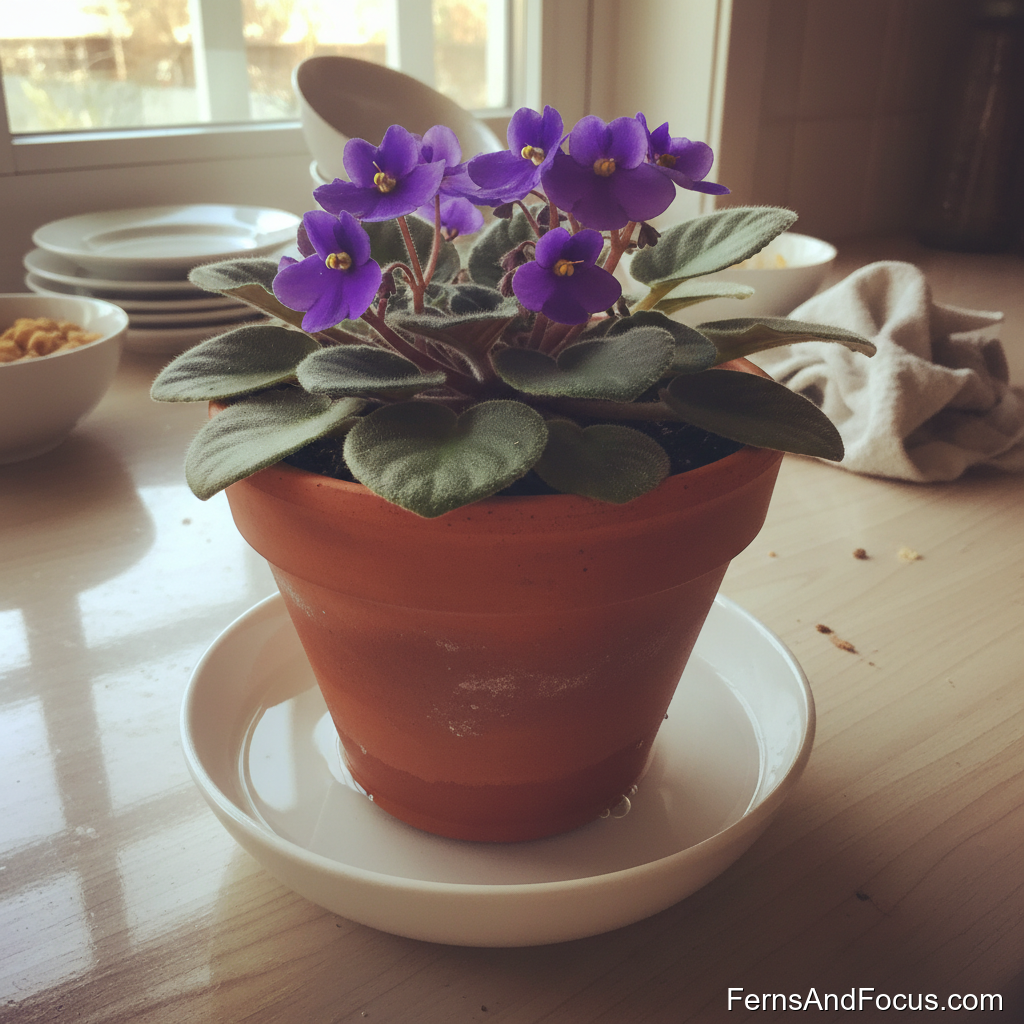
But once a month, you must perform a heavy “top-flush” using room-temperature distilled water or rainwater. This flushes out the accumulated mineral salts from fertilizers that naturally build up on the soil surface and container rim, which can otherwise chemically burn the leaf stems (petioles).
Edaphic Architecture: Engineering the Root Zone
The root system of an African Violet is fine, fibrous, and very delicate. It lacks the thick taproots needed to push through heavy or compacted soil. To keep these roots happy, you have to engineer their foundation for a specific volumetric balance: 50% solids, 25% air, and 25% moisture. This ensures that oxygen is always available for the roots to breathe, even when the soil is damp.
I never use regular garden soil or even standard potting mix—they are simply too heavy. Instead, use a “soilless” matrix. The industry standard is a mix of high-quality sphagnum peat moss amended with 50% perlite or vermiculite. The peat provides the organic base and a naturally slight acidity (aim for a pH of 6.0 to 6.5), while the perlite ensures there are permanent air pockets that never collapse. Physics is more important than nutrients here. Over time, peat breaks down and becomes more acidic, and fertilizer salts accumulate. To prevent “nutrient lockout” where the roots can’t absorb food even if it’s there, you must perform a mandatory annual substrate replacement (repotting). Think of it as a fresh start for the plant’s plumbing.
Container Science: The One-Third Rule
When it comes to the container, size isn’t just about space; it’s about geometrical induction. African Violets exhibit a physiological preference for root restriction. If the pot is too large, the plant will spend all its metabolic energy exploring that massive soil volume with its roots and producing foliage, entirely skipping the blooming phase. To “force” a violet to bloom, you must keep it slightly root-bound.
The non-negotiable rule is the One-Third Rule: the diameter of the pot should be precisely one-third the diameter of the leaf span. If your plant is 9 inches across, it belongs in a 3-inch pot. Furthermore, the depth of the pot is critical. Never use a standard deep nursery pot. These create an anaerobic reservoir at the bottom where water pools and the fine roots can’t reach, leading to rot. Use shallow “azalea” or “squat” pots that match the shallow nature of the root system. For material, I prefer plastic for consistency. Terracotta is too porous and draws fertilizer salts outward, creating a caustic crust along the rim that can rot the leaf petioles on contact.
Nutritional Mastery: The “Weekly-Weakly” System
In the highly sterile, soilless mixes we use, the natural nutrient cycle is absent. You have to provide the fuel for year-round growth. I never recommend a monthly heavy feeding; it causes osmotic shock and can burn the delicate root hairs. Instead, use a “constant feed” system, often called “weekly-weakly.” Take a balanced fertilizer (one specifically designed for Gesneriads with higher phosphorus for blooms) and dilute it to one-quarter of the recommended dosage. Administer this low-dose solution with every single watering event.
This system provides a steady trickle of nutrients that mimics the slow decomposition of forest floor leaf litter. It keeps the plant in a state of high metabolic readiness. But you must watch the foliage for markers of health. If the oldest bottom leaves start to yellow uniformly, the plant is likely Nitrogen-deficient and needs a slightly stronger concentration. If the leaves become abnormally stiff, erect, and develop a purplish underside, you have a Phosphorus deficiency. Conversely, if you see orange or white crusting on the soil surface, your dilution is too low and you are building up toxic salts. Balance is the highest form of stewardship.
Mechanical Maintenance and Grooming
The fuzzy leaves of an African Violet are actually a highly efficient mechanical trap for dust and dander. A heavy layer of dust is not just ugly; it physically blocks the stomata and reduces the surface area available for the plant to catch light. To keep the plant healthy, you must perform routine mechanical grooming. Use a soft-bristled artist’s paintbrush or a cosmetic brush to gently sweep dust from the leaves, starting at the base and moving toward the tip. Always support the leaf with your other hand; the petioles are brittle and will snap easily.
If the contamination is heavy, you can safely wash the leaves with lukewarm water. The trick is the “Tilt-Wash” protocol: physically tilt the pot at an angle so that the water flows off the leaf and away from the central crown. Water that pools in the crown is the primary vector for fatal rot. After washing, place the plant in a warm, shaded spot with good airflow until the leaves are 100% dry. Never let bright light hit a wet leaf, as the water droplets act like tiny magnifying glasses, causing permanent thermal burns (brown spots). Finally, systematically remove any “suckers”—small lateral shoots that emerge from the main stem. These drain massive amounts of energy and ruin the plant’s natural circular symmetry.
Rejuvenation Surgery: The Neck Correction
As an African Violet ages, it naturally sheds its bottom leaves while growing new ones from the center. Over time, this creates a bare, woody stem called a “neck.” This neck is a structural failure; it makes the plant unstable and distances the crown from its nutrient source. Correcting this requires an intimidating surgical move: decapitation.
Pull the plant from the pot and strip away any lower leaves that are limp or yellow until you have a tight, healthy central rosette. Using a sterile blade, cut the woody stem so that only about an inch remains protruding beneath the healthy leaves. Discard the entire original root system. Next, use your blade to gently scrape the brown, hardened tissue off the remaining one-inch stub until you see the fresh green cambial layer beneath.
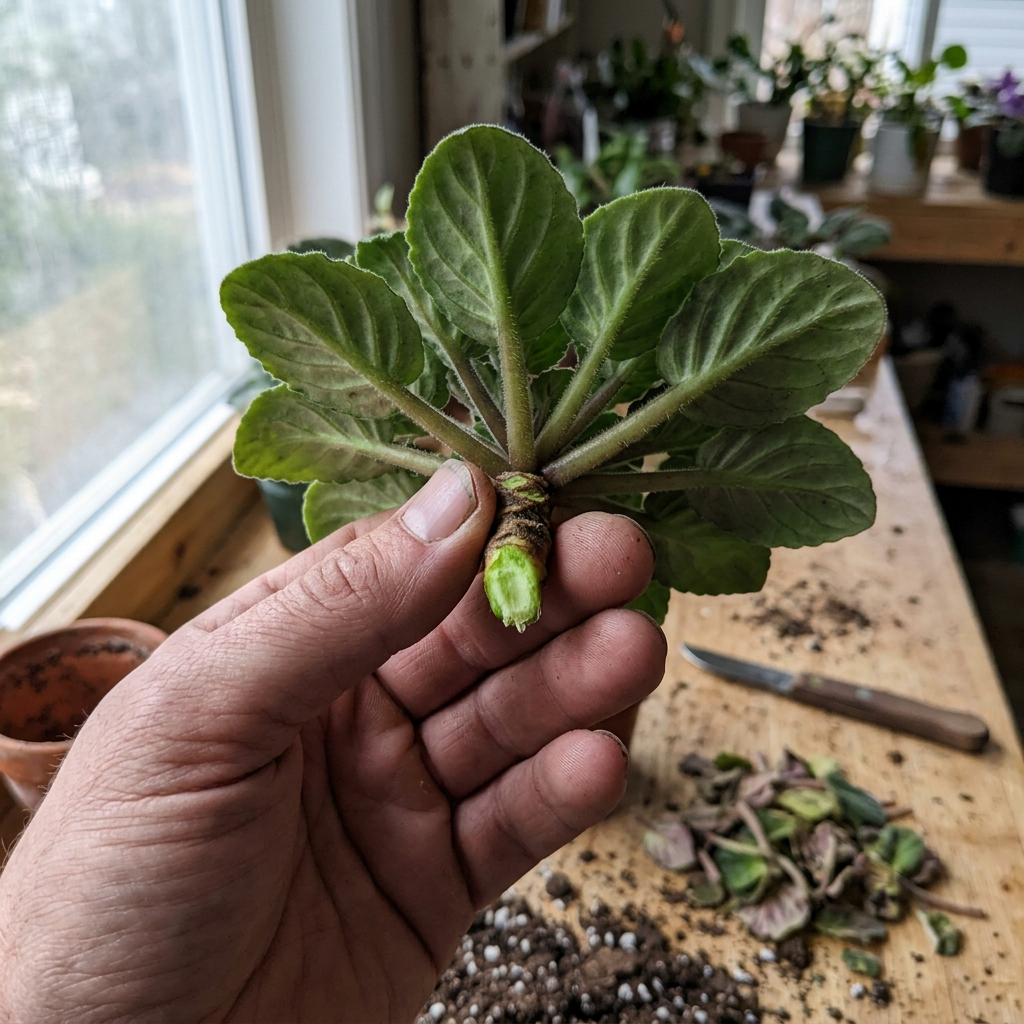
Prepare a fresh pot of dampened propagation mix (50/50 perlite and peat) and bury the scraped neck straight down until the lowest leaves are flush with the rim. To survive this surgery, the plant must be placed in a clear plastic bag or humidity dome. This creates a 100% humidity micro-environment that stops transpirational water loss while the plant spends the next 30 to 45 days growing a brand-new root system. Once you see new growth in the center, you can slowly acclimate the plant back to normal air. It’s an aggressive move, but it’s the only way to reset the plant’s lifecycle.
Propagation: The 45-Degree Strategy
African Violets exhibit extraordinary cellular totipotency—the ability of a single leaf cell to create a whole new plant. The most reliable way to multiply your collection is through leaf cuttings. Choose a healthy, firm leaf from the middle row of the plant. Avoid the bottom leaves (too old) and the center leaves (too young). Snip the leaf petiole and then make a final, sharp cut at a 45-degree angle, leaving about 1.5 inches of stem. This angle maximizes the surface area of the vascular cambium, which is where the new roots will emerge.
Place the stem into a sterile, porous rooting medium like a 50/50 mix of perlite and vermiculite. Don’t just shove it in; use a pencil to create a pilot hole to avoid crushing the delicate tissue. Water the mix, then place the entire cutting inside a clear plastic bag or a transparent bakery clamshell.
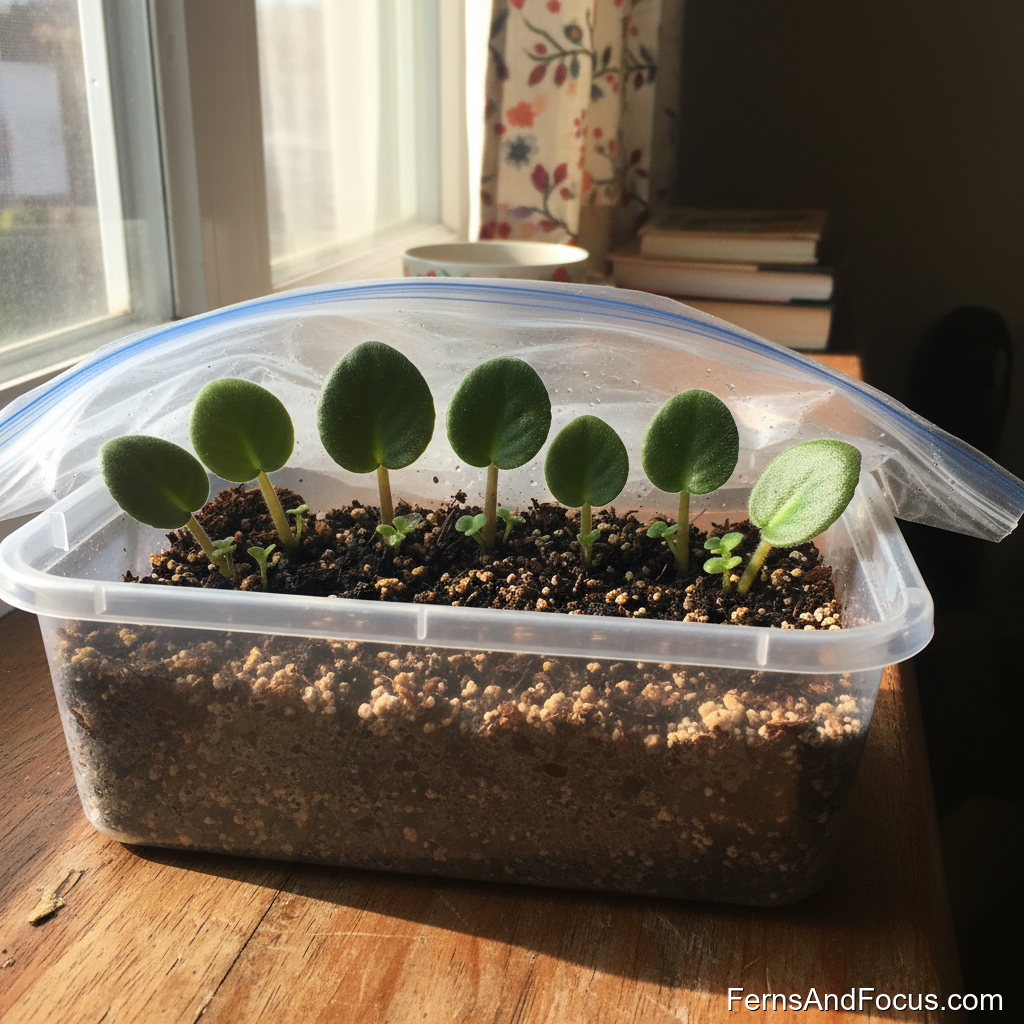
This mini-greenhouse keeps the humidity at 100%, allowing the leaf to focus its energy on growing roots rather than surviving dry air. In 3 to 4 weeks, you’ll have roots, and in 6 to 8 weeks, you’ll see tiny “mouse ear” plantlets emerging from the soil. Once they have 4 to 6 leaves, you can separate them and pot them individually. It is a slow, quiet miracle that starts with a single leaf and a sharp angle.
Si’s Pro-Tip
If your violet is growing in a lopsided way, it’s because it’s reaching for the light. Every time you check the soil weight, give the pot a quarter-turn. This simple mechanical move ensures that every leaf gets its fair share of photons, maintaining the perfect circular rosette that these plants are famous for. Symmetry is a sign of a mentor who is paying attention to the angles.
Keep your hands dirty and your plants happy.
About the Author
Silas
The Practical Greenhouse Mentor
"Silas treats the greenhouse like a workshop of practical results. After 40 years of dirty hands, he’s learned that thriving plants are the result of honest observation and small, correct moves rather than luck. He’s the neighbor who knows exactly why your Pothos is pouting and how to fix it without the fuss."