
The Finger Test vs. Moisture Meters: Stop Guessing
Why cheap probes give false readings and how to use your senses to master the mechanical weight of water.
The Quick Dirt
The most common way people kill their plants is by drowning them. They buy a cheap moisture meter and trust the needle. But that needle does not know the difference between wet soil and a high salt count. If you want to know if a plant is thirsty, you need to use your hands and your head.
1. The Meter Myth
I see these little green probes in every big-box store. They usually end up in a drawer after someone’s favorite plant turns into mush. People buy them because they want a shortcut to success. But the mechanical reality of these gadgets is pretty flimsy. Most of these cheap meters are not actually measuring moisture levels. They are measuring electrical conductivity. They have two different metals in the probe that create a tiny electrical current when stuck into a wet environment. The more current, the higher the needle goes.
The problem is that water is not the only thing that conducts electricity in your soil. Fertilizer is made of salts. Tap water is full of minerals like calcium and magnesium. Over time, those salts build up in the pot. If you have been heavy-handed with the plant food, your soil might be bone-dry. But because there is a high concentration of salt around the probe, the needle will fly over to the “Wet” zone. I have seen people let their plants wilt to death because a ten-dollar gadget told them everything was fine.
Even worse, these probes cannot account for soil density. In a loose, chunky aroid mix, the probe might not make enough physical contact with the medium to get a reading. It stays on “Dry” even after a heavy watering. In a dense, peat-heavy soil, it might get stuck on “Wet” for weeks because the air pockets are gone. A machine does not have the context to know what kind of plant it is looking at. It does not know what the soil chemistry looks like. You are betting your plant’s life on a mechanical oversimplification. Use the tools nature gave you. Use your senses.
2. The Lift Test
Water is heavy. A gallon of water weighs about eight pounds. When you soak a pot of soil, you are adding a significant amount of mechanical weight to the container. This is the most honest way to tell if a plant is thirsty. Before you even think about sticking your finger in the dirt, just lift the pot. I do this every morning as I walk through the greenhouse. I do not need a meter. I just need to feel the gravity.
If you are using plastic nursery pots, the lift test is incredibly accurate. A dry 6-inch pot of Pothos will feel like it is filled with feathers. A wet one will feel solid and substantial. You need to develop a baseline for your plants. Next time you repot or buy a new plant, hold the pot when it is bone-dry. Memorize that weight. Then, soak it until water runs out the bottom and lift it again. That is your range. Anything in the middle is your caution zone. It takes a few weeks to get the muscle memory. Once you have it, you can check a whole shelf of plants in thirty seconds.
If you are using terra cotta, the physics are a bit different. The clay itself has weight and can hold moisture. A wet terra cotta pot will feel heavy and cool to the touch. A dry one will feel lighter and room temperature. This is why I love terra cotta. It gives you two different mechanical signals at once. You can feel the weight of the water in the soil. You can also feel the moisture in the walls of the pot. If the pot feels light and the clay feels dry and warm, the plant is definitely looking for a drink. Do not overthink it. Trust what your arms are telling you.
3. The Knuckle Method
If the lift test and the weight check are not giving you a clear answer, you have to go to the source. The top of the soil is a mechanical liar. It is exposed to the air, the fans, and the heat of the room. It always dries out first. You can have a pot where the top inch is bone-dry dust, but the bottom three inches are a stagnant, muddy swamp. If you water just because the surface looks dry, you are going to rot the roots. You have to get your finger down to where the roots actually live.
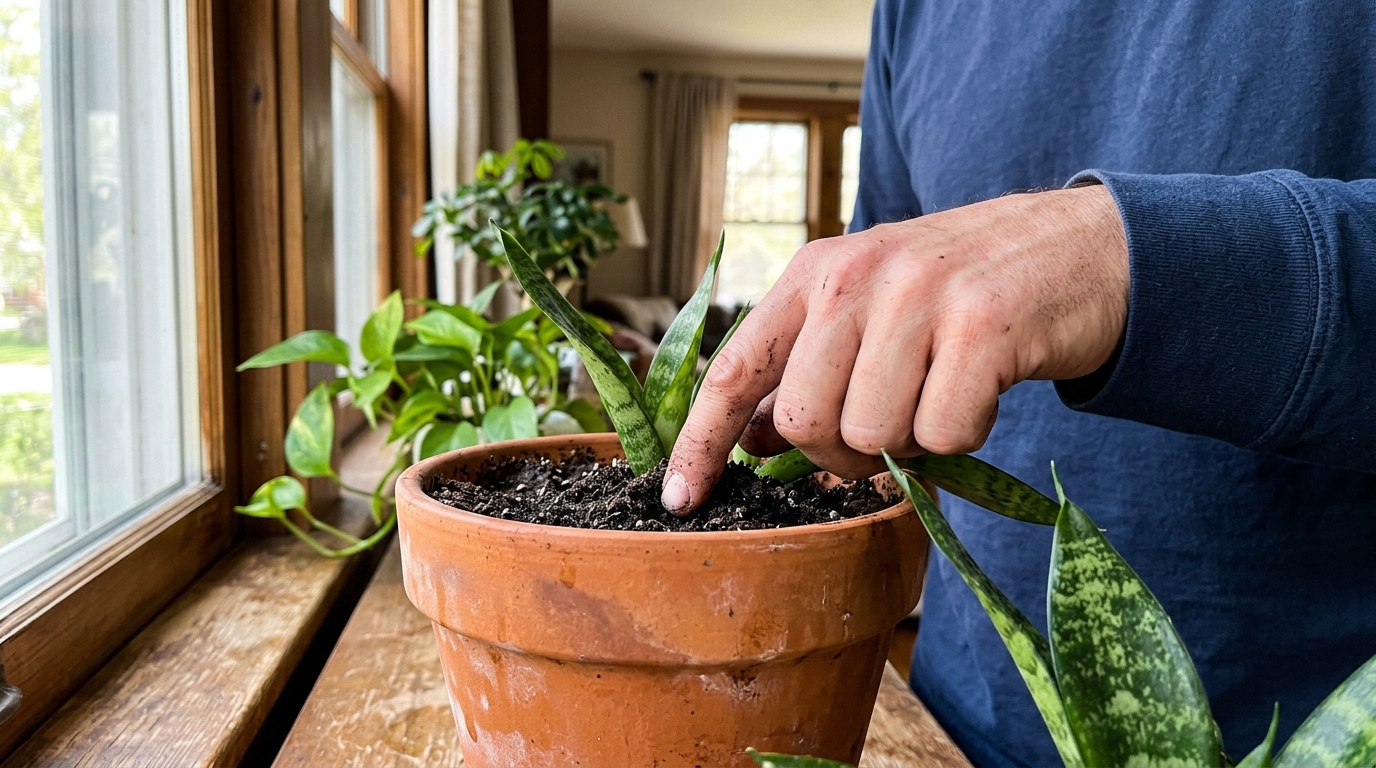
Stick your finger into the soil up to the second knuckle. You are looking for two specific things: temperature and texture. Wet soil is naturally cooler than dry soil because of evaporation. If you poke your finger in and it feels cold and clingy, there is plenty of moisture down there. Leave it alone. If it feels warm and crumbly, like dry coffee grounds, the plant is ready for a drink. If you can feel the grit of the soil without any stickiness, the water is gone.
Do not be afraid to pull your finger out and look at it. If you have dark soil sticking to your skin, that is a sign of moisture. If your finger comes out clean and dusty, the soil is dry. This is the most direct diagnostic tool we have. It tells you exactly what the mechanical state of the root zone is without any guesswork. It might not be as clean as a moisture meter, but it is one hundred percent accurate. A little dirt under the fingernails is a small price to pay for a plant that is not drowning.
Si’s Pro-Tip
If you have a deep pot and cannot reach the bottom, use a wooden chopstick or a bamboo skewer. Jam it down into the soil, leave it for a minute, and pull it out. If the wood is dark and damp, the bottom of the pot is still wet. It is basically a dipstick for your plants.
Keep your hands dirty and your plants happy.

About the Author
Silas
The Practical Greenhouse Mentor
"Silas treats the greenhouse like a workshop of practical results. After 40 years of dirty hands, he’s learned that thriving plants are the result of honest observation and small, correct moves rather than luck. He’s the neighbor who knows exactly why your Pothos is pouting and how to fix it without the fuss."