
Root Health: The Foundation of Growth
Why your plant's roots need oxygen as much as they need water. Learn the mechanics of soil physics and pot selection.
The Quick Dirt
In the greenhouse, we spend all our time looking at leaves, but the real work happens in the dark. If your roots can’t breathe, your plant can’t grow. Success isn’t about feeding the plant; it’s about managing the physics of the soil to ensure oxygen and water are always in balance.
The Respiratory Root: Why Oxygen is Mandatory
It is a common mistake to think that roots only exist to drink water and anchor the plant. In reality, roots are respiratory organs. Just like you and me, they need to take in oxygen and exhale carbon dioxide to stay alive. This process is what drives the energy production needed for the plant to push out new leaves and build new tissue. If the oxygen supply is cut off, the roots begin to suffocate.
Think of it as a mechanical “breath” for your container. When you water your plant, that water pushes the “old” air out of the bottom of the pot. As the water drains away, it pulls fresh, oxygen-rich air back into those spaces between the soil particles. This is the lungs of your plant at work. If the soil is too dense or stays saturated for too long, those air spaces are permanently filled with water. Within 24 to 48 hours, the roots will start to die from lack of oxygen. This is why “overwatering” isn’t about the amount of water you give—it’s about the lack of air in the soil over time. You have to allow the system to exhale before you force it to inhale again.
Soil Architecture: Designing for Air Pockets
To build a healthy root system, you must think like an architect. The “nutrients” in your soil are secondary to the “structure.” Most off-the-shelf potting soils are composed of fine peat moss or coco coir. While these materials are great for holding moisture, they are very “sharp”—meaning they pack together tightly and eliminate air spaces. This is what I call compacted soil, and it is a mechanical barrier to growth.
To fix this, you must introduce macroscopic air spaces using inorganic grit. Materials like perlite, pumice, and horticultural bark are the structural “beams” of your soil. They don’t break down easily, and they force the soil to remain porous. When you mix 30% to 50% grit into your soil, you are creating a network of tiny tunnels that allow oxygen to flow deep into the pot even after a heavy watering. This architecture prevents the soil from becoming a solid, suffocating brick. If your soil feels like a hard lump when it’s dry, it is too compacted. A healthy root zone should always feel springy and loose, allowing the roots to explore the container without resistance. Think of your soil as a sponge with thousands of tiny rooms, not a solid slab of mud.
Pot Physics: The Role of the Drainage Hole
The drainage hole is the most important part of your pot. Without it, you are managing a closed system where water has nowhere to go but stay at the bottom. This leads to what we call a “mechanical failure” of the root system. If the water can’t get out, the air can’t get in.
I often hear the advice to put “rocks at the bottom” of a pot without holes. This is a dangerous myth that has killed more plants than I can count. Adding a layer of gravel actually raises the water level closer to the roots, giving them even less space to breathe. This is because of capillary action—the water wants to stick to the soil particles more than it wants to fall into the gaps between the rocks. The only true way to manage moisture is through a large, clear drainage hole. When you see water running out of the bottom of your pot, you aren’t just seeing waste; you’re seeing the “exhale” of your container. It’s the signal that the system is working and fresh oxygen is being pulled in behind the water.
Container Selection: Speed Controllers for Metabolism
The material of your pot is a mechanical decision that affects the speed of the dry-down cycle. Think of the pot as a speed controller for your plant’s metabolism. Terracotta is the gold standard for many indoor plants because it is porous. The clay walls allow for gas exchange and moisture evaporation across the entire surface area of the pot, not just the top. This effectively increases the “lung capacity” of your root zone. For plants that hate wet feet, like succulents or Snake Plants, terracotta provides a natural safety buffer that helps pull excess water away from the core.
Plastic and glazed ceramic pots are non-porous. They hold moisture for much longer because evaporation only happens at the soil surface. These are excellent for moisture-loving plants like ferns or Calathea, but they require much more precision from the gardener. In a plastic pot, you must be more vigilant about the “Finger Test” because the soil in the middle can remain saturated for days after the surface looks dry. Choosing the right material is about matching the container to the plant’s natural rhythm. If you have a slow-growing plant in a non-porous pot, you are running a high risk of stagnant moisture. Success is about choosing the right safety buffer for your specific species.
Underground Audits: Finding the Truth
Root health is often a “silent” failure because we can’t see the work happening underground. You have to learn to perform audits without always pulling the plant out of its home. The first sign of trouble is often found in the nose. Healthy soil should smell like damp earth or nothing at all. If you detect a sour, sulfurous, or “swampy” odor when you get close to the pot, you have anaerobic bacteria thriving in stagnant water. This is a clear signal that the oxygen supply has failed and the roots are starting to rot.
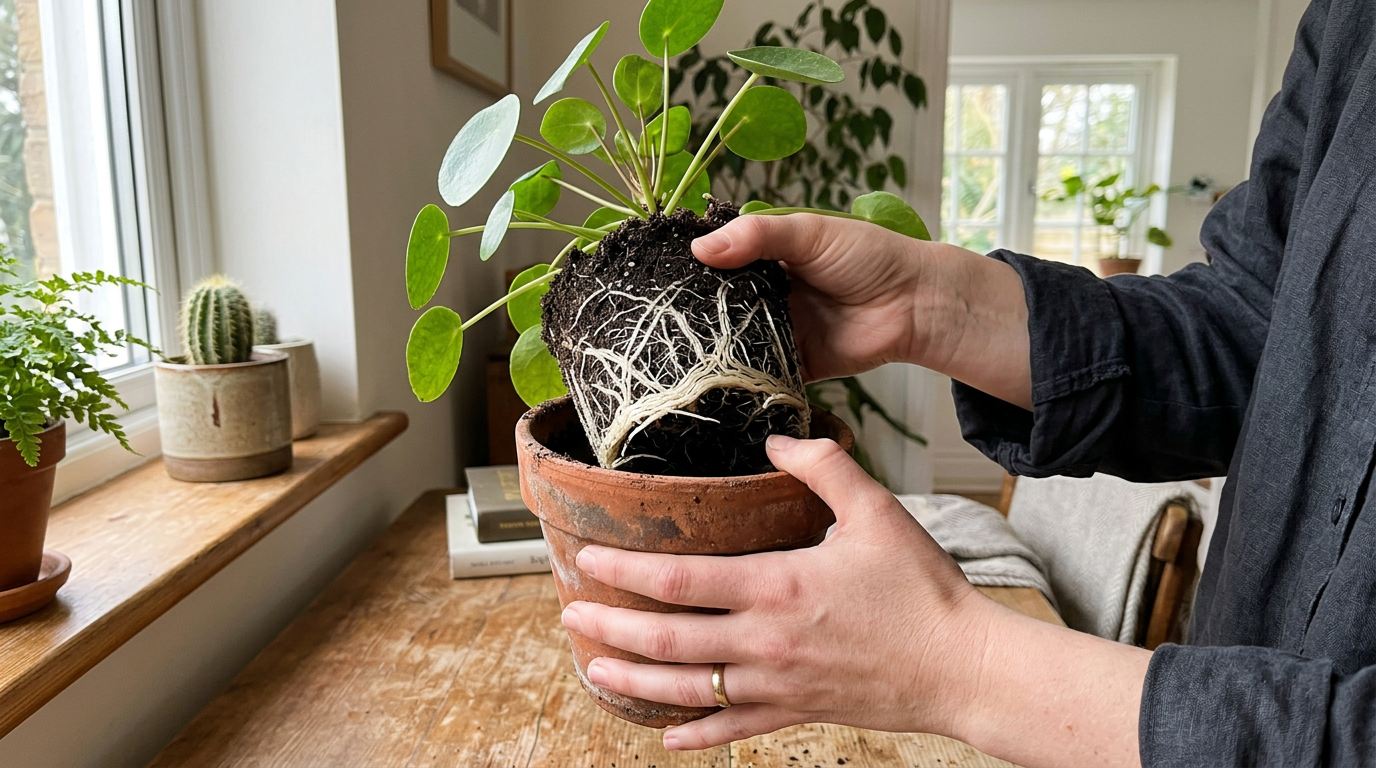
Another reliable tool is the “Lift Test.” A pot full of wet soil is heavy; a pot full of dry soil is surprisingly light. Get to know the “weight of health” for your favorite plants. If a pot remains heavy for more than a week, the roots aren’t drinking because they are likely damaged or suffocating. If you are still unsure, you may need to gently lift the plant out of its pot to inspect the color. Healthy roots are firm and usually white or light tan. Rotting roots are black, slimy, and will easily pull away from the plant with a gentle tug. This audit is the only way to move from guessing to knowing. In the greenhouse, observation is the highest form of care.
Si’s Pro-Tip: The Cache Pot Drain
If you’re using a decorative “cache pot”—a pot without holes that holds a plastic nursery pot—never let water sit in the bottom. After watering, wait 15 minutes, then lift the inner pot and dump any excess liquid from the decorative one. That half-inch of standing water creates a high-humidity trap at the bottom of the root ball that prevents oxygen from being pulled in. It’s a small mechanical move that can prevent 90% of root rot cases. It ensures that the “exhale” we talked about actually happens. Success is just a series of small, correct moves.
Keep your hands dirty and your plants happy.
About the Author
Silas
The Practical Greenhouse Mentor
"Silas treats the greenhouse like a workshop of practical results. After 40 years of dirty hands, he’s learned that thriving plants are the result of honest observation and small, correct moves rather than luck. He’s the neighbor who knows exactly why your Pothos is pouting and how to fix it without the fuss."