
The Magic of Multiplication: Propagation for Beginners
Why buy new plants when you can copy-paste your favorites? Silas shares the magic of water and soil propagation and how to multiply your jungle.
The Magic of Multiplication: Propagation for Beginners
The Quick Dirt
Propagation is the most rewarding skill you can learn in the greenhouse. It’s essentially the “copy-paste” of the plant world. Whether you want to gift a piece of your favorite plant to a neighbor or just fill a bare shelf for free, propagation is how you turn one success into a dozen.
The Deep Dive
I’ve always thought of propagation as a quiet form of magic. You take a small piece of a living thing, put it in a jar of water, and watch as it decides to start a whole new life. But before you snip, you have to understand the “engine” of the plant.
Node Knowledge: The Biological Engine
The secret is all in the node. If you look at a stem of a Pothos (Epipremnum aureum) or a Monstera (Monstera deliciosa), you’ll see little bumps or joints where the leaves emerge. That’s the node. It’s the only place on the stem that has the “instructions” to grow a new root. If you cut a leaf but miss the node, it might stay green for a month, but it will never grow a root system. Always include at least one node in your cutting.
Method 1: Water Propagation (The Transparent Jar)
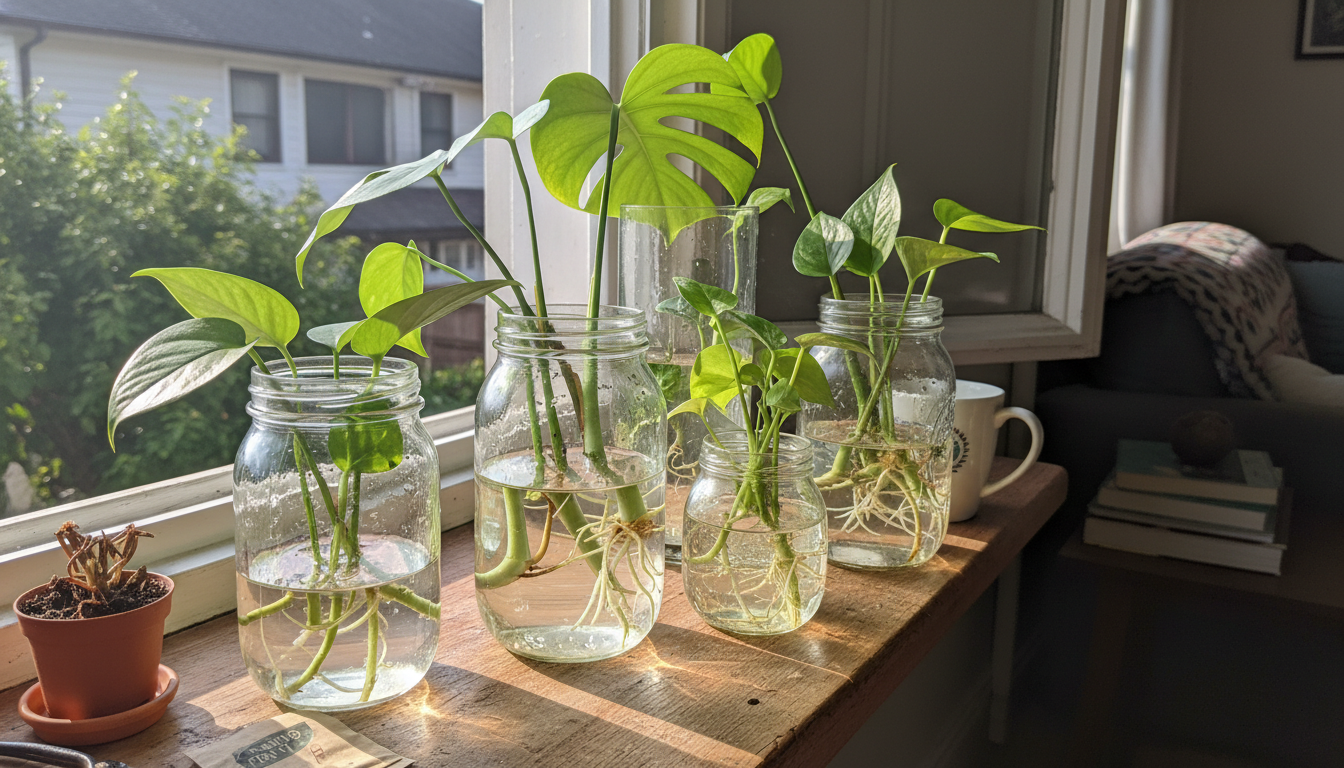
This is where I tell everyone to start. It’s simple, and it lets you see the progress in real-time.
- How to do it: Take a cutting with two or three leaves. Remove the bottom leaf so the node is bare, and drop it in a glass of clean water.
- The Pro: It’s highly satisfying to see that first tiny white root nub appear. Gardening is a practice of patience, and watching water roots grow is a great way to ground yourself.
- The Con: Water roots are different from soil roots—they are more fragile. When you move the plant to soil later, it might go through a week of “shock” as it adjusts to its new home.
Method 2: The “Prop Box” (The Humid Sanctuary)
For my more “woody” cuttings, like a Hoya or a Snake Plant, I prefer a bit of perlite and a lid.
- How to do it: Fill a clear container with damp perlite or moss. Lay your cuttings inside and close the lid to trap the humidity.
- The Pro: The high moisture and air circulation create incredibly strong roots that are ready for soil the moment they appear. It has a much higher success rate for rare plants.
When is it Ready for a Pot?
The biggest mistake I see is potting up too early. A single one-inch root isn’t enough to support a whole plant in the heavy soil. Wait for “roots on roots.” You want to see secondary branching—little roots growing off the main ones. Once you have a few inches of branched roots, the plant is ready for its permanent home.
The Focus Moment
Propagation teaches us that growth often begins with a separation. By snipping a piece of your favorite plant, you aren’t hurting it; you’re giving it a chance to multiply its presence in the world. It’s a lesson in generosity and renewal. Keep your hands dirty and your mind clear, and soon you’ll have more plants than you have windowsills.
Want more plant tips? Follow us on Facebook!
About the Author
Silas
The Practical Greenhouse Mentor
"Silas treats the greenhouse like a workshop of practical results. After 40 years of dirty hands, he’s learned that thriving plants are the result of honest observation and small, correct moves rather than luck. He’s the neighbor who knows exactly why your Pothos is pouting and how to fix it without the fuss."