
Pothos: The Efficiency Expert
Stop growing thin vines and start building a dense, healthy Pothos. Silas explains the physics of growth and why pruning is your best tool.
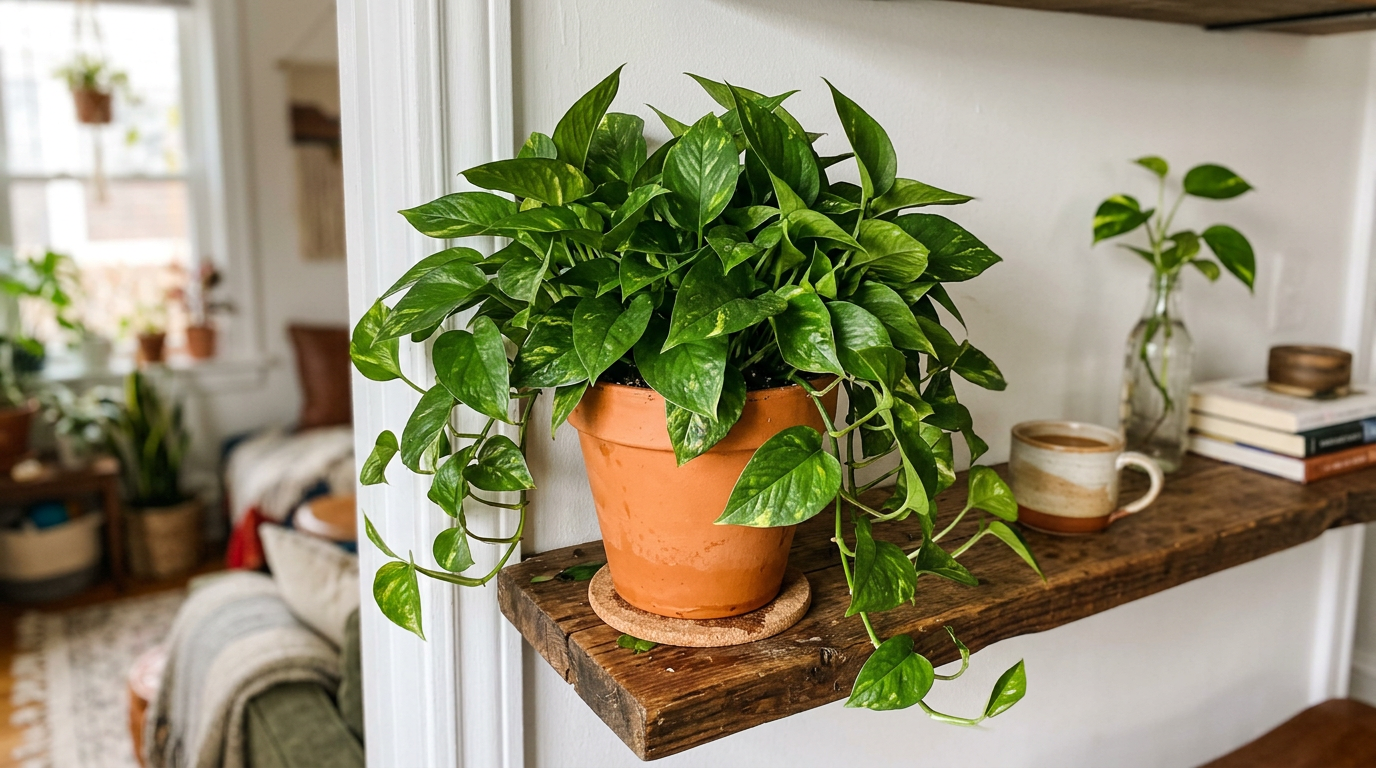
Pothos: The Efficiency Expert
The Quick Dirt
A ten-foot Pothos vine with tiny, sparse leaves isn’t a success. It is a sign of a plant struggling to transport nutrients. To grow a truly healthy Pothos, you need to focus on density and light capture. By understanding the mechanics of growth and the power of a good pair of scissors, you can turn a leggy vine into a lush, efficient machine.
The Deep Dive
I. The Length Fallacy: Quality over Vines
I have seen it a thousand times. A gardener walks into my greenhouse and proudly shows me a photo of a Pothos vine. They have draped it all the way around their living room. “Look how long it is!” they say. I look at the photo and see a thin, bare stem with three or four tiny leaves at the very end. That isn’t a healthy plant. That is a plant that is slowly starving to death.
Think of a Pothos vine as a mechanical transport system. The roots are the pump and the leaves are the solar panels that provide the power. The further those leaves are from the roots, the harder the pump has to work to push water and nutrients through the stem. When a vine gets too long without enough light, the plant starts to triage its resources. It lets the older leaves die off. It only supports a few tiny ones at the very tip where it is hunting for sun.
True success in the greenhouse isn’t about length. It is about density. A three-foot Pothos with large, lush, overlapping leaves is a high-performance machine. It is capturing more light and building more energy than a twenty-foot vine ever could. If your Pothos is looking leggy, it is time to stop measuring and start cutting.
II. Light Capture: The Physics of the Leaf
Leaf size is a direct response to light intensity. In the deep shade of a rainforest floor, a Pothos will grow massive leaves to catch every stray photon. But in our homes, we often do the opposite. We put them in dark corners and expect them to grow. When a Pothos isn’t getting enough light, it doesn’t just grow slower. It grows smaller.
If you have a Golden Pothos, you have an extra mechanical challenge. Those beautiful yellow splashes are actually areas where the plant lacks chlorophyll. They are dead zones in the solar panel. While they look great, they are highly inefficient. If you put a variegated Pothos in low light, it will eventually revert to solid green. It is a survival move. The plant is trying to maximize its photosynthetic surface area to survive the dim conditions.
If you want those massive, plate-sized leaves you see in the tropics, you need to provide the power. Bright, indirect light is the fuel for leaf expansion. Without enough photons, the plant will never have the energy to build anything more than those tiny, coin-sized leaves.
III. Pruning: The Growth Redirector
Pruning is the most misunderstood tool in the greenhouse. Most people think cutting a plant makes it smaller. In the long run, it is exactly the opposite. Pruning is how you redirect the plant’s energy to where you want it.
It all comes down to a hormone called auxin. This hormone is produced at the very tip of the vine. Its job is to tell all the other nodes on that stem to stay dormant. It is a top-down mechanical control system. When you snip off that growing tip, you break the circuit. Suddenly, all those dormant nodes lower down the stem wake up and start pushing out new growth.
If you want a bushy, dense Pothos, you have to be willing to cut. Snip back those long, thin vines. Stick the cuttings back into the soil or water them first. You aren’t just making the plant shorter. You are telling it to build density instead of length. It is the difference between a long, weak wire and a short, powerful battery.
IV. Climbing vs. Trailing: The Vertical Advantage
Pothos is often sold as a trailing plant, but that is not what it was designed for. In its natural home, it is a climber. Those aerial roots you see along the stem are mechanical anchors. They want to grab onto a tree trunk and pull the plant upward.
When a Pothos starts to climb, something amazing happens to its biology. The leaves start to get much larger. Eventually, they will even develop fenestrations—the same kind of holes you see in a Monstera. This is because the plant feels its way up. It senses the vertical stability and puts its energy into leaf size instead of stem length.
If you want the most efficient Pothos in the room, give it something to climb. A moss pole or a rough piece of wood will do. If those aerial roots can latch on, the plant will build a massive, high-efficiency leaf system that will put any trailing vine to shame.
V. Maintenance: The Clean Solar Panel
If you want your efficiency expert to keep doing its job, you have to help it out. In our homes, dust is the biggest mechanical barrier to growth. It settles on the leaves and physically blocks the light from reaching the chlorophyll.
Dust can also block the stomata. These are the tiny, microscopic holes on the underside of the leaf that the plant uses for gas exchange. If a leaf can’t breathe, it can’t build energy. Use a damp, soft cloth to gently wipe your Pothos leaves every few weeks. Not only does it make the plant look better, but it literally improves its engine performance.
When you water, I always use the Lift Test. A massive, healthy Pothos with a dense root system will be surprisingly light when it is thirsty. If the pot feels heavy, the pump doesn’t need any more fuel yet. Wait until it is light, and then give it a thorough, deep soak.
Si’s Pro-Tip
If your Pothos is trailing and you want more density at the soil line, don’t just prune. Take a long vine and wrap it in a circle around the top of the pot. Pin the nodes against the soil. Those nodes will eventually root and push out new growth tips. This gives you a full, bushy look without having to take a single cutting.
Keep your hands dirty and your plants happy.

About the Author
Silas
The Practical Greenhouse Mentor
"Silas treats the greenhouse like a workshop of practical results. After 40 years of dirty hands, he’s learned that thriving plants are the result of honest observation and small, correct moves rather than luck. He’s the neighbor who knows exactly why your Pothos is pouting and how to fix it without the fuss."