
The Solar Panel Cleaning Service: Dust and Efficiency
Why dusty leaves are slowing down your plant's engine and how to fix it.
The Quick Dirt
Your plant’s leaves are its engine. If they’re covered in dust, they can’t catch the light they need to build energy. Keeping them clean isn’t about looking pretty. It’s about keeping the mechanical system running at full power.
1. Light Physics
Think of a leaf as a specialized solar panel. It is a piece of biological machinery designed to catch photons and turn them into sugar. Inside that leaf, you’ve got a dense layer of chlorophyll. This is the engine that keeps the whole system running. But here is the mechanical reality of living indoors: you are already operating at a deficit. Even a bright window only provides a fraction of the light a plant would get in its natural habitat. When dust settles on that surface, it creates a physical, opaque barrier. This blocks those photons from ever reaching the engine.
I have seen houses where the dust is so thick you could write your name in it. People wonder why their Fiddle Leaf Fig is dropping its bottom leaves. It is not a mystery. It is a brownout. Every speck of dust is a tiny shadow. When you multiply that by the millions of particles in a typical home, you are looking at a 20% to 50% reduction in light efficiency. If the plant cannot get the light, it cannot run its photosynthesis cycle. It starts to starve. It literally consumes its own energy reserves to stay alive. It is not just stagnant. It is slowly cannibalizing itself.
Wiping that barrier away is like taking a dirty filter out of an air intake. You are effectively giving the plant a massive power boost without moving it an inch. In the wild, rain and wind do this job for free. Indoors, that machine is sitting in stagnant air. It collects every bit of skin dander, pet hair, and city soot that floats through the vent. If you are not the rain, nobody is. Give those leaves a clear path to the light. You will see the plant respond within a week. It is the simplest, most direct mechanical upgrade you can give your indoor garden.
2. Stomata Logic
If you look at the surface of a leaf through a microscope, you will see thousands of tiny, mouth-like openings called stomata. These are not decorative. They are the mechanical valves of the plant’s respiratory and cooling system. Their job is to pull in carbon dioxide for the photosynthesis engine. They also vent out oxygen and water vapor. This process, called transpiration, creates the “pull” that brings water and nutrients up from the roots. It is a delicate mechanical balance. Dust is the wrench in the gears.
When a layer of household grime settles on the leaves, it physically seals those valves shut. This grime is often a mix of dust and sticky kitchen grease. It is exactly like trying to run an engine with a clogged exhaust pipe. If the plant cannot vent water vapor, its internal temperature starts to rise. In a hot room, a plant with clogged stomata can literally cook itself from the inside. This happens because its primary cooling mechanism is offline. Without that “pull” from transpiration, the roots stop bringing up the minerals the plant needs to build new cells.
You might notice your plant looks tired or has limp leaves even though the soil is wet. That is a classic system failure. The water is there, but the mechanical pump (the stomata) is stuck. This leads to stagnant water sitting in the leaf tissues. Stagnant water is an open invitation for bacterial rot and fungal infections. Keeping those leaves clean ensures the valves can open and close as they need to. It keeps the pressure in the system exactly where it should be. Do not let a little bit of dust turn into a total mechanical breakdown. Wiping them down is how you keep the pump primed and the air flowing.
3. Maintenance Steps
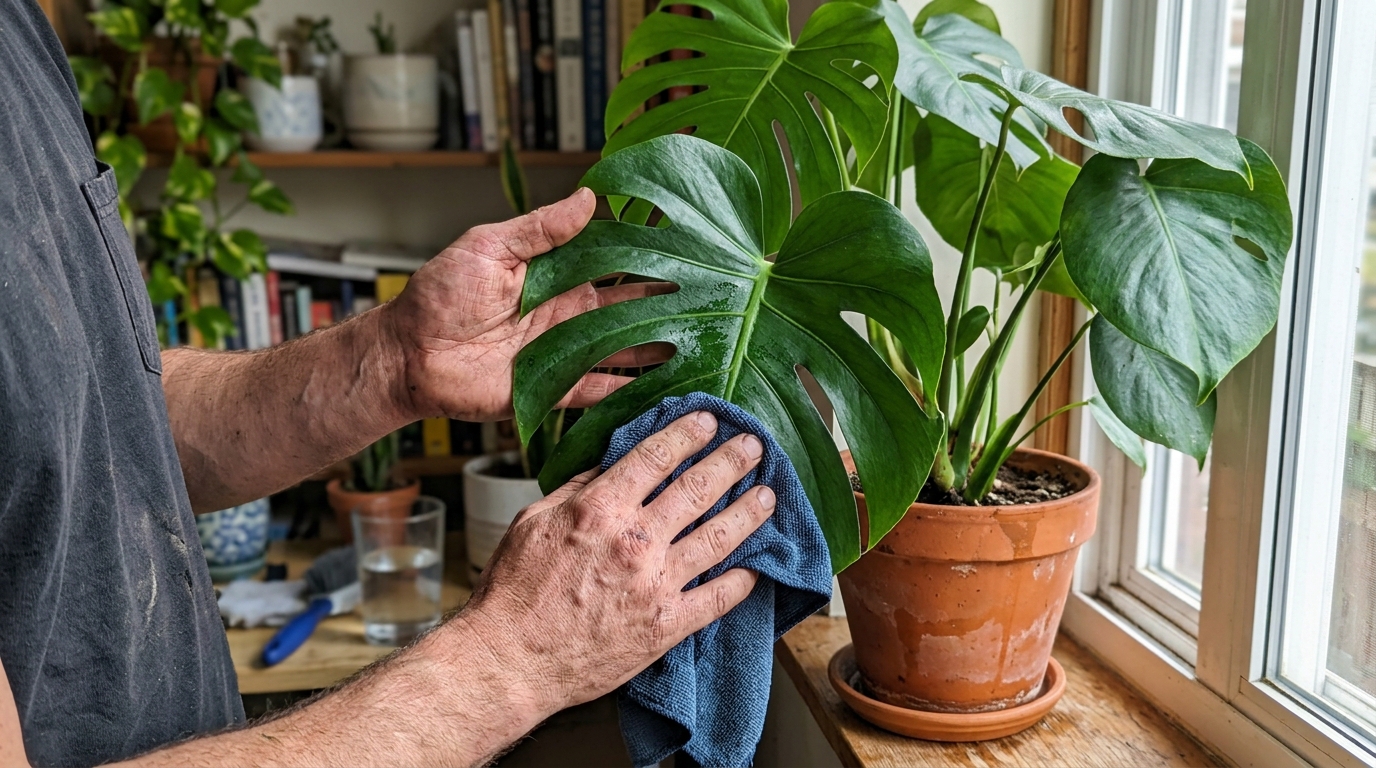
Cleaning your plants does not have to be a major chore. You do need to be precise about how you handle the machinery. For plants with large, structural leaves like a Monstera, a Bird of Paradise, or a Rubber Tree, your best tool is a clean, damp microfiber cloth. Do not just wipe the top. Support the leaf from underneath with your palm. These leaves are heavy. The connection point at the stem (the petiole) is a mechanical hinge. If you press down too hard without support, you can cause micro-fractures or snap the leaf right off. Use gentle, circular motions to lift the dust rather than grinding it into the surface.
For smaller, more intricate plants like Pothos, Ivy, or Ferns, the wipe method is a nightmare. Instead, take them to the sink or the shower for a gentle rain. This mimics the mechanical cleaning they get in nature. But here is the critical part: use lukewarm water. If the water is too cold, you risk cold water shock. For many tropicals, cold water hitting the leaves can cause the cells to collapse. This leads to permanent white or brown spots that never go away. You want the water to feel just slightly warm to the touch. Aim for about 70 to 80 degrees.
Stay away from those commercial leaf shine sprays. They are the mechanical equivalent of pouring wax over your car’s radiator. Those sprays are usually made of oils or waxes that create a synthetic gloss. While they look healthy for a day, they end up trapping dust like a magnet. They permanently seal the stomata we just talked about. I have seen plants literally suffocate because they were coated in that junk. If you want a natural shine, a drop of mild dish soap in a quart of water is all you need to cut through the grease. Keep it simple. Keep it clean. Keep the chemicals out of the engine.
Si’s Pro-Tip
If you have a plant with fuzzy leaves, like an African Violet, do not use a wet cloth. Water trapped in those hairs can lead to rot and ugly brown spots. Use a soft, dry paintbrush to flick the dust off. It is like a detailing job for your plants.
Keep your hands dirty and your plants happy.

About the Author
Silas
The Practical Greenhouse Mentor
"Silas treats the greenhouse like a workshop of practical results. After 40 years of dirty hands, he’s learned that thriving plants are the result of honest observation and small, correct moves rather than luck. He’s the neighbor who knows exactly why your Pothos is pouting and how to fix it without the fuss."