
The Air Plant Protocol: They Need More Than Just Air
Stop the slow death of your Tillandsia. Silas rants about the set and forget marketing and explains the mechanics of the weekly bath.
The Air Plant Protocol: They Need More Than Just Air
The Quick Dirt
The term air plant is a marketing trick. It has killed more Tillandsia than any pest. They aren’t living sculptures. They are biological systems that need water, light, and airflow. If you want to keep yours alive, stop misting and start soaking.
The Deep Dive
I. The Marketing Myth: Why “Set and Forget” is Dead
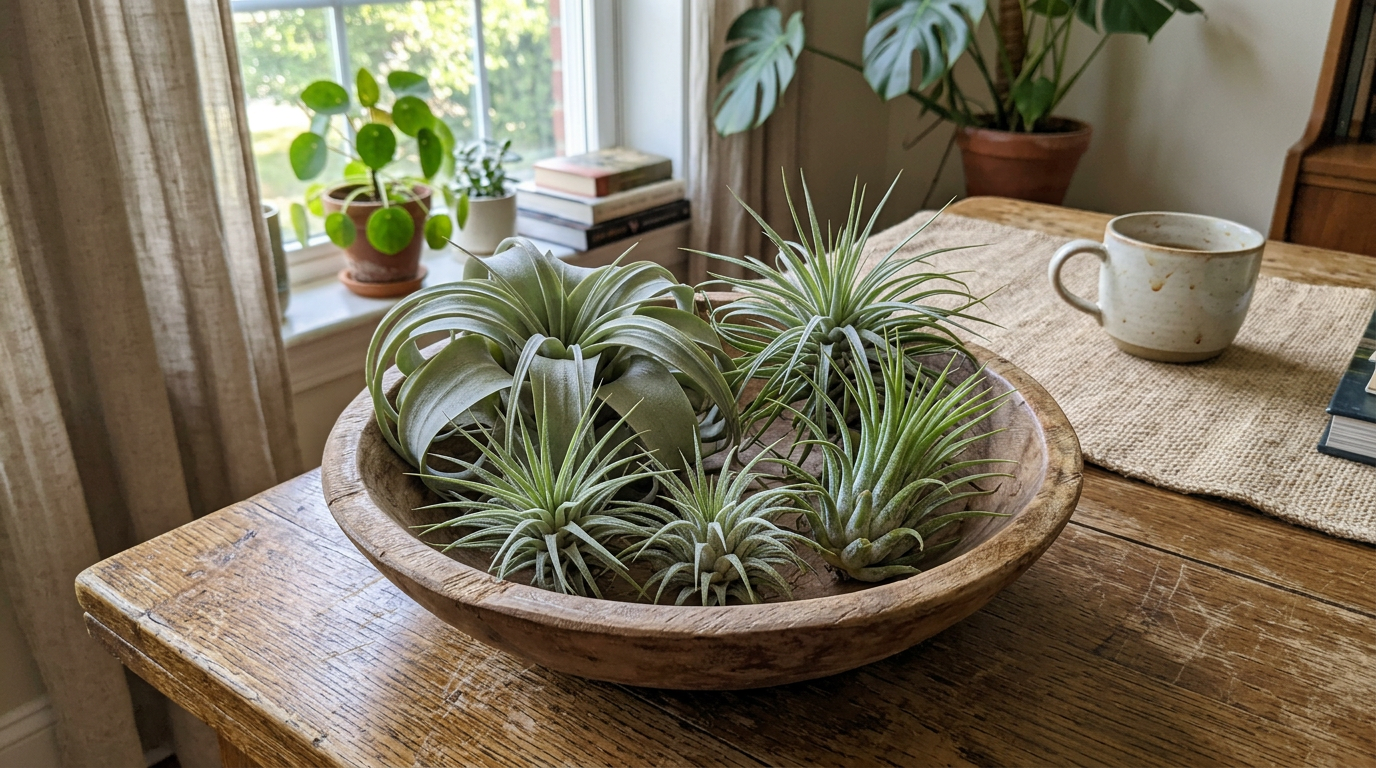
I see them everywhere. They are in little glass globes or glued to pieces of driftwood. They are sold as the ultimate low-maintenance plant. Marketing says they just live on air. That is rubbish. No plant lives on just air.
Mechanically, a Tillandsia is an epiphyte. It evolved to live without soil. It replaced roots with specialized scales called trichomes. These are the fuzzy, silver-grey scales on the leaves. They aren’t just for show. They are biological tools. They pull water and nutrients from the air and rain.
If you live in a climate with high humidity, maybe your air plant could survive on just air. But in a home with the furnace running, that plant is slowly drying out. Air is only ten percent of the survival equation. The rest is water and light.
II. Hydration Mechanics: The Weekly Bath
Most people spray their air plants with a misting bottle. They think they have done their job. But misting is a surface-level fix. It doesn’t allow the trichomes to recharge the internal reservoir of the plant.
For forty years, I have used the Weekly Bath protocol. Once a week, take your air plants and submerge them in a bowl of lukewarm water. Leave them for twenty to thirty minutes. This allows the plant to fully rehydrate. You will see the color change from silvery-grey to deep green. That is the plant filling up its biological battery.
The most important part is the drip-dry rule. After the bath, shake out any excess water. Place the plant upside down on a towel. If water gets trapped in the base of the plant, it will rot from the inside out. Once an air plant’s crown is mushy, there is no mechanical fix.
III. Light and Airflow: The Engine Fuel
Many air plants are placed in dark corners as decor. This is a slow death. Light is the engine fuel for an air plant. Without enough photons, it cannot process the water you give it.
You need to know if you have a Xeric or a Mesic air plant. Xeric plants come from dry, sunny climates. They have thicker, fuzzier silver-grey leaves. They need bright, direct light. Mesic plants come from more humid, shaded forests. They have thinner, greener leaves. They prefer bright, indirect light.
Do not forget the air movement. These plants have air in their name for a reason. They need airflow to dry out after a rain or a bath. If you put an air plant in a closed globe with no circulation, you are creating a mechanical death trap. Give them the light they need and the air they crave.
IV. Maintenance: Trimming and Grooming
Even a healthy air plant will show some dry leaves at the base. This is the natural mechanical lifecycle of the plant. As it grows from the center, the older leaves are phased out to save resources.
Gently peel off the dry leaves at the base of the plant. If the tips of the leaves are brown but the rest is healthy, you can trim them. Use sharp, clean scissors. Follow the same rule as you would for a palm. Do not cut into the green part of the leaf.
Watch for the pre-bloom color shift. Many air plants turn bright red or pink as they prepare to flower. This is the plant signaling its final life phase. It is a spectacular mechanical transformation. It is a sign that you have the protocol right.
V. Blooming and Pups: The Multiplication Cycle
Blooming is the final, high-energy goal for an air plant. Once the flowers fade, the mother plant will slowly stop growing. This can take years. Do not throw it away yet. The plant will use its remaining energy to produce pups. These are tiny, miniature versions of itself that grow from the base.
This is the multiplication cycle. You can let the pups cluster together for a fuller look. Or you can gently separate them once they are about one-third the size of the mother plant. This is the only way to propagate air plants mechanically.
Stick to the protocol. Give them the bath, the light, and the air. Air plants are far from disposable decor. They are fascinating survivors that bring a touch of the wild into your home.
Si’s Pro-Tip
If your air plant looks very dry, give it a long overnight soak in lukewarm water. This can jump-start a plant that has been neglected. Just make sure you follow the drip-dry rule afterward to avoid rot.
Keep your hands dirty and your plants happy.

About the Author
Silas
The Practical Greenhouse Mentor
"Silas treats the greenhouse like a workshop of practical results. After 40 years of dirty hands, he’s learned that thriving plants are the result of honest observation and small, correct moves rather than luck. He’s the neighbor who knows exactly why your Pothos is pouting and how to fix it without the fuss."