
Blue Bird Jade Care
Keep Crassula arborescens 'Blue Bird' compact and blue with strong light, soak-and-dry watering, and a gritty mix that lets the roots breathe.


Blue Bird Jade
Crassula arborescens 'Blue Bird'
Care Level
Easy
Light
Full Sun
Water
Low
Humidity
Low
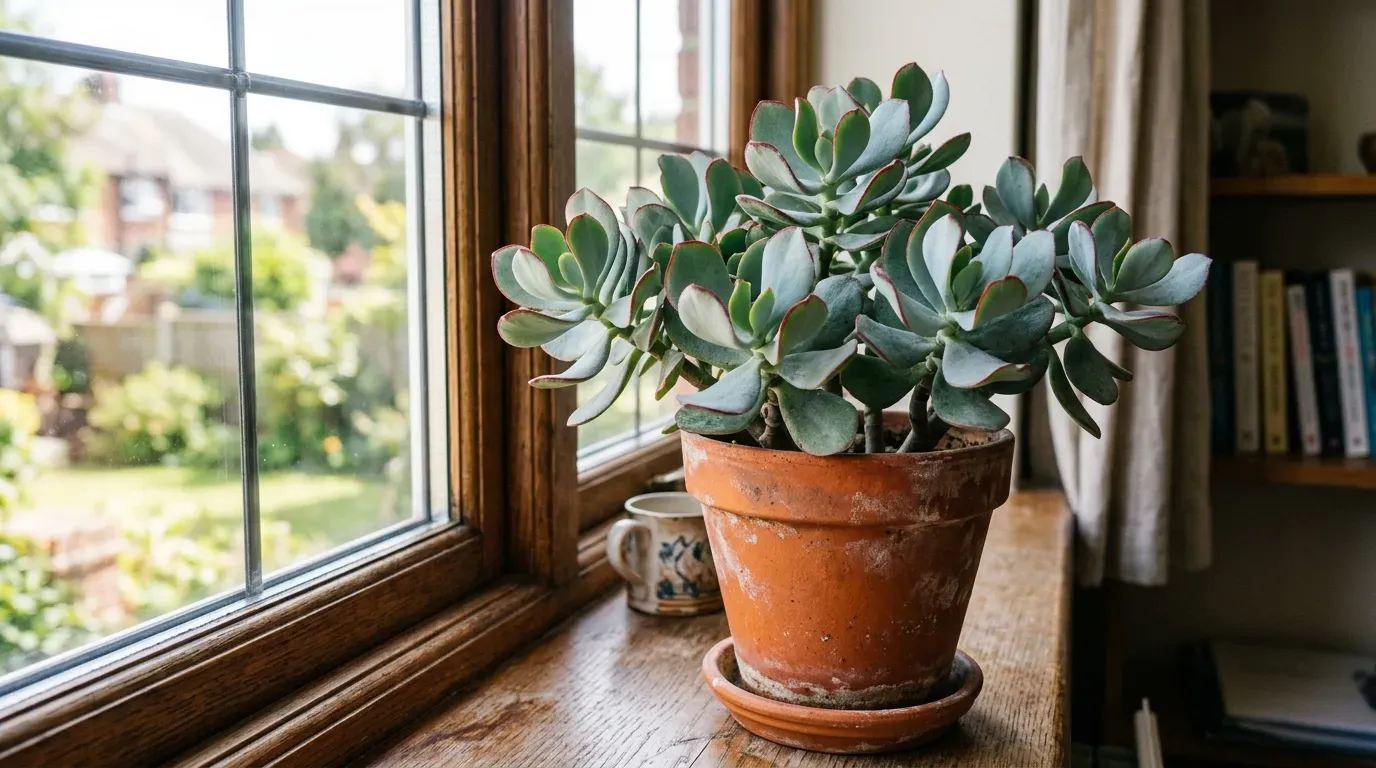
The Crassula arborescens ‘Blue Bird’ (Blue Bird Jade) loses its compact form and silvery-blue color when light is weak or the mix stays wet. Overwatering is the usual failure, not neglect.
Plant pros weigh in on the baseline: strong light for many hours a day, a pot with drainage holes, and a full dry-down between thorough soaks. Red leaf margins in firm foliage are a healthy sun response, not a crisis.
Full plant profile: /plant/blue-bird-jade/.
Quick Facts
- Difficulty: Easy
- Light: Full sun or very bright indoor light for many hours a day
- Water: Soak thoroughly, then wait until the mix is completely dry
- Pet Safety: Toxic to cats, dogs, and horses if eaten
Light Requirements
Strong light keeps growth tight and the blue color honest. Six hours of direct sun is the outdoor ideal. Indoors, a south window is the best match. An east window can work if the plant sits close to the glass. Weak light stretches stems, shrinks leaves, and washes the blue toward plain green.
Red margins are a healthy sun response when leaves stay firm. True scorch looks bleached or crispy on the sun-facing side. Ease a winter-indoor plant into harder light over a week if you move it outdoors for summer.
Rotate the pot regularly. A one-sided lean means the brightest window is still not enough on the back face.
Watering Schedule
Use soak-and-dry. Drench until water leaves the drainage holes, dump the saucer, then wait. The mix should dry top to bottom. In bright warmth that may be every two to three weeks. In winter, stretch to once a month or longer.
Check leaves by touch. Firm, plump paddles mean the plant still holds a reserve. Soft, wrinkled leaves usually mean it is time to water. Yellow, translucent, or dropping leaves with wet soil point the other way: too much water, too often.
Do not run a weekly calendar. Soil feel and leaf feel are the schedule. When unsure, wait. Jade roots forgive drought far better than a swamp.
Humidity & Temperature
Average home humidity is fine. High humidity is not a goal. Wet air plus cool nights slows drying and raises rot risk at the stem base.
Keep temperatures roughly 65°F to 80°F for steady growth. Protect the plant below 50°F. Do not leave it against freezing glass in winter. Bring outdoor plants inside before cold nights arrive.
Stable warmth beats dramatic swings. A plant that is happy in one bright spot should stay there.
Soil & Potting
Use a gritty succulent or cactus mix with extra perlite or pumice. Roots need air pockets after every watering. Heavy potting soil stays wet against the woody stem and invites rot.
A simple mix:
- Two parts cactus or succulent mix
- One part pumice or perlite
Always use a drainage hole. Terra cotta helps the mix dry and steadies a plant that gets top-heavy as the trunk thickens. Blue Bird Jade tolerates being slightly root-bound. Repot every two to three years in spring, moving up only one pot size.
After repotting, wait a few days before the first deep watering so damaged roots can seal.
Fertilizer
Feed lightly during spring and summer. A balanced water-soluble fertilizer diluted to half strength every four to six weeks is enough. Fresh mix already holds some nutrition, so do not stack feedings on a newly potted plant.
Hold fertilizer in winter when growth slows. Extra salts in a resting plant burn leaf edges and do not create a thicker trunk. If a white crust appears on the soil, flush with plain water and pause feeding.
Fertilizer is not a fix for low light or wet roots. Correct light and drainage first.
Pruning & Maintenance
Prune to shape the miniature tree. Cut just above a leaf node with clean shears. The plant often pushes two new shoots from that point, which builds a denser canopy over time. Remove dead or soft branches at the base.
Wipe dusty leaves with a damp cloth. Dust blocks light on those broad paddles. While you clean, check leaf axils for mealybugs.
Keep the plant out of reach of pets. High shelves beat wishful thinking.
Propagation
Stem cuttings are the fastest path. Take a healthy tip, strip the lower leaves, and let the cut callus for a few days in dry air. Then set it in barely moist gritty mix under bright light. Wait to water heavily until you feel resistance from new roots.
Leaf cuttings also work. Place a whole leaf on dry grit after the wound calluses. Roots and a tiny plantlet form at the base over weeks. Keep the medium barely damp, never soggy.
Callus first, roots second. That order prevents the most common propagation rot.
Common Problems
Root rot: Mushy stems and collapsing leaves after wet soil. Cut to firm tissue, callus, and restart in dry grit with longer gaps between waterings.
Leaf drop: Often underwatering extremes or sudden temperature shifts. Stabilize light and temperature, then return to a patient soak-and-dry cycle.
Mealybugs: White cotton in joints. Treat with alcohol on a swab or insecticidal soap as directed, and isolate until clear.
Leggy growth: Not enough light. Move closer to a bright window before you prune for shape. Pruning without light only repeats the stretch.
Pet exposure: Toxic if eaten. Place it where cats and dogs cannot browse.
Pro Tips for Long-Term Maintenance
If the leaves look thirsty but the pot still feels heavy, trust the pot weight. Soft leaves over wet mix often mean roots are already failing, not that the plant needs another drink. Let it dry, improve drainage if needed, and only then resume careful soaking.

About the Author
Silas
The Practical Greenhouse Mentor
"Silas treats the greenhouse like a workshop of practical results. After 40 years of dirty hands, he’s learned that thriving plants are the result of honest observation and small, correct moves rather than luck. He’s the neighbor who knows exactly why your Pothos is pouting and how to fix it without the fuss."